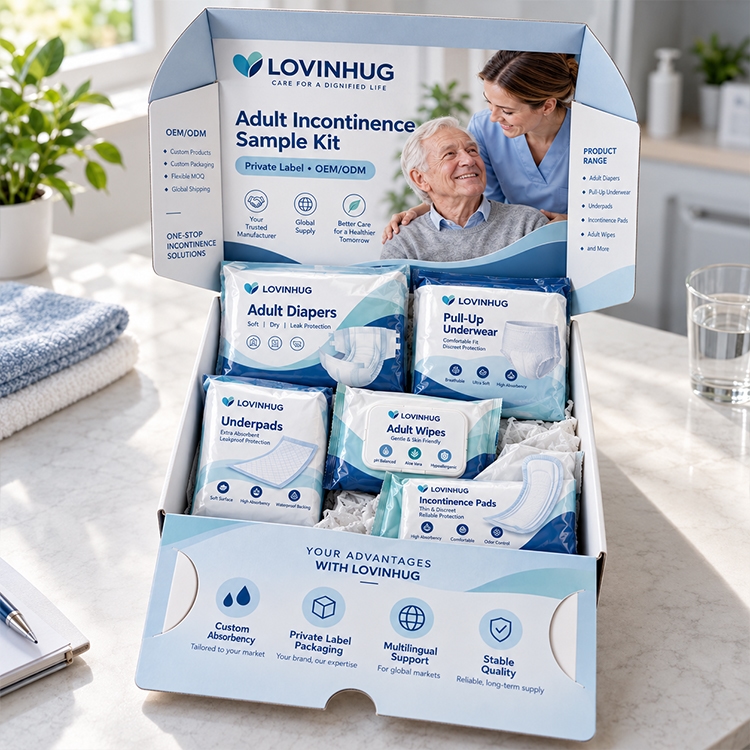
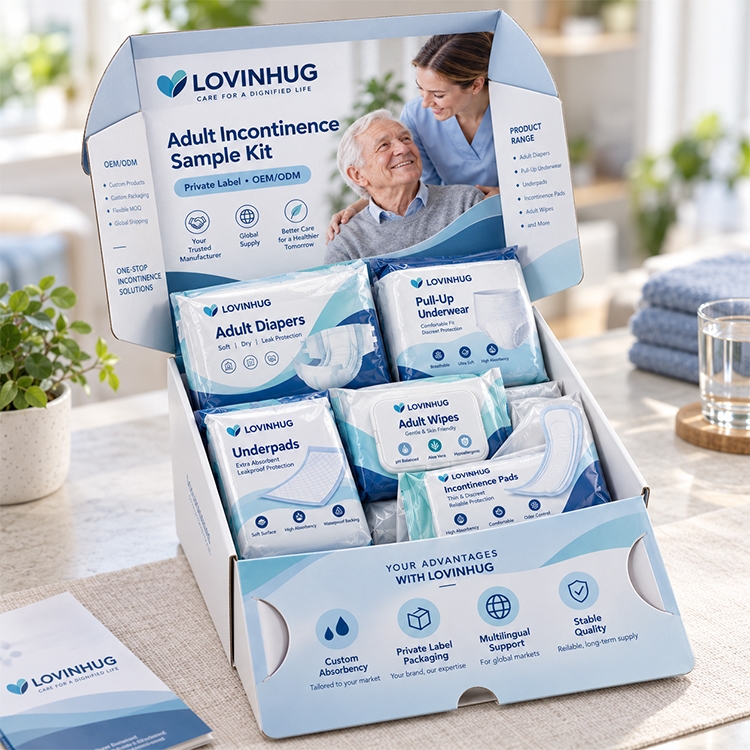
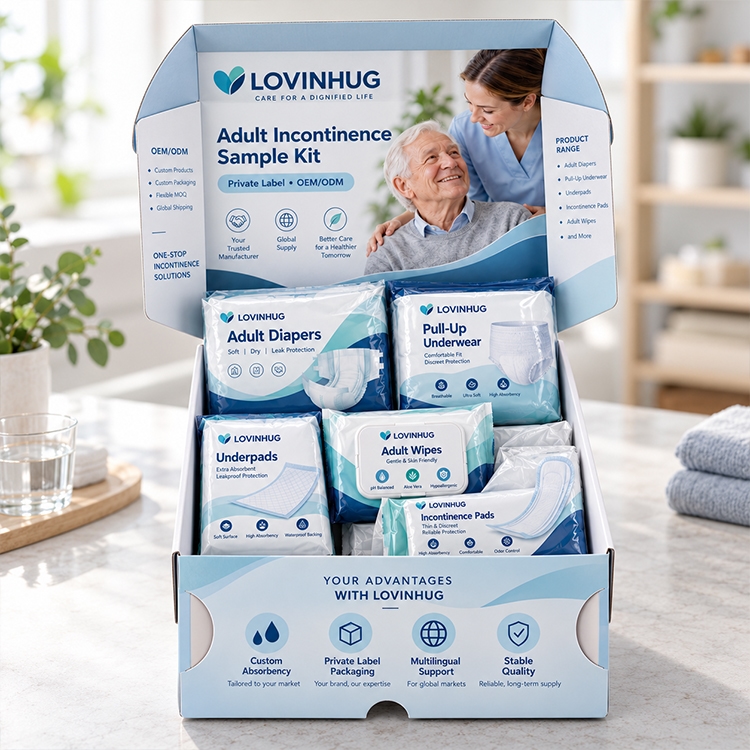
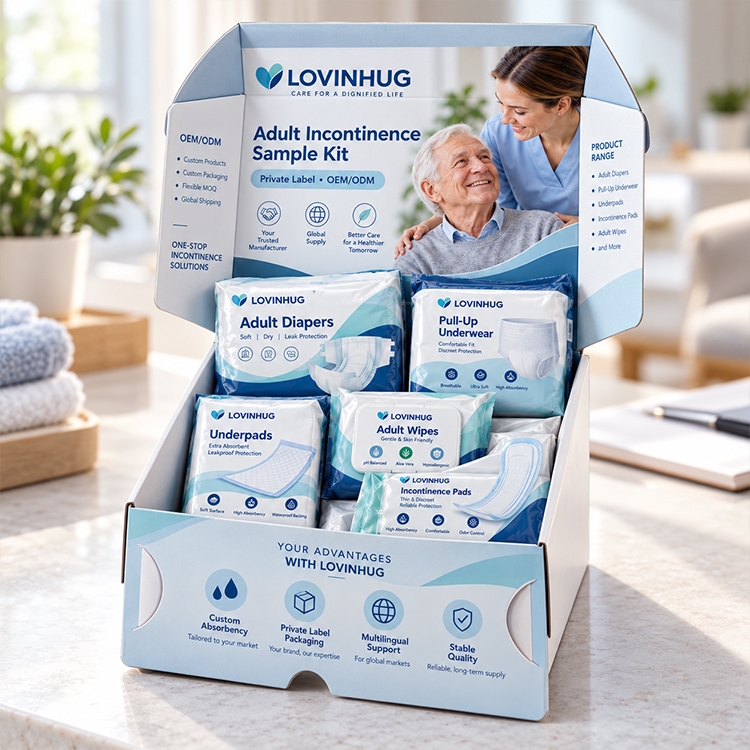
How to Design Distributor Sample Kits for Adult Incontinence Products
Most adult incontinence product sample kits are built backward.
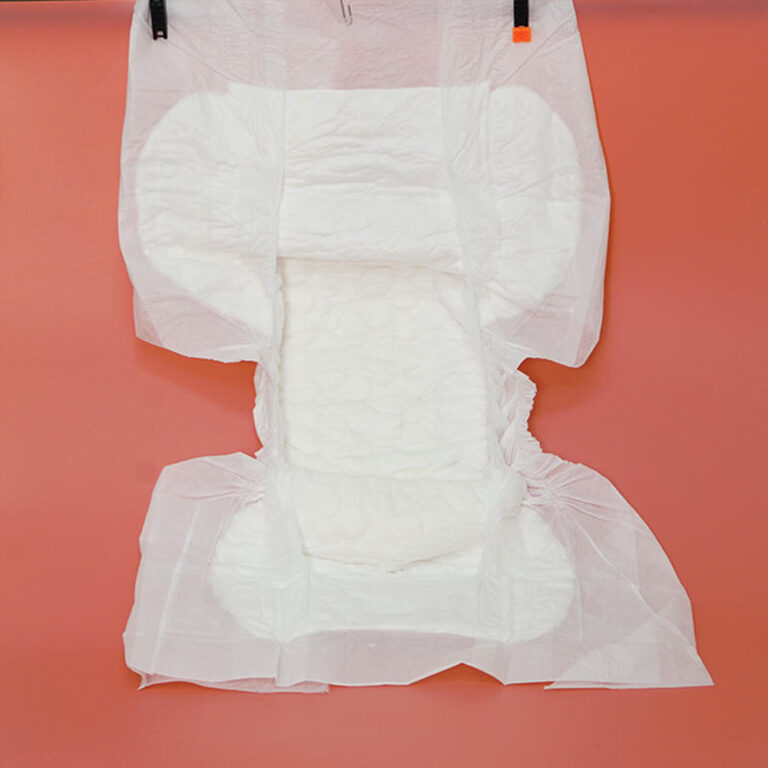
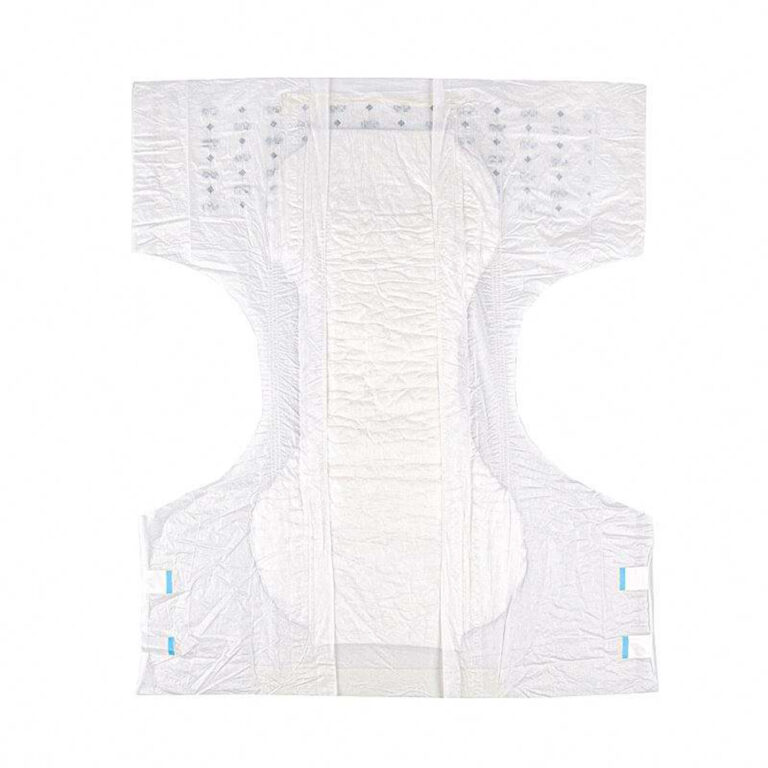
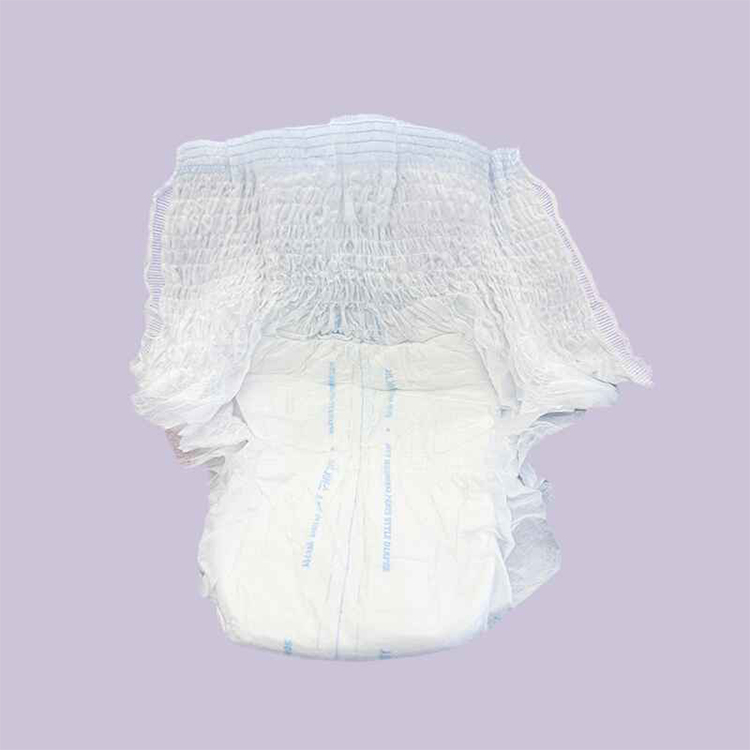
Someone walks into the sample room, grabs an adult brief, a pull-up, perhaps an underpad, stuffs everything into a courier carton, adds a catalog, and calls the job finished. The package may contain good products. It still makes a bad sales kit.
I have a simple rule: a distributor sample kit should shorten a purchasing decision.
That matters because adult incontinence is not one neat consumer segment. The U.S. National Institute of Diabetes and Digestive and Kidney Diseases says approximately half of women experience urinary incontinence, while as many as one in three men over 65 may experience accidental urine loss. Those figures describe very different bodies, mobility levels, care settings, absorbency requirements, and purchasing channels.
A serious distributor does not merely ask, “Is this diaper soft?”
They ask whether they can sell it.
A Distributor Sample Kit Is a Decision Tool, Not a Gift Box
Samples expose everything.
When a buyer can physically compare tab placement, cuff height, core width, waistband recovery, backsheet feel, product thickness, wet strength, package dimensions, and SKU positioning in the same sitting, vague claims such as “premium quality” suddenly become much harder for a supplier to hide behind.
So why send samples without the information needed to judge them?
A good incontinence sample kit should answer five commercial questions before the distributor schedules another call: What problem does each SKU solve? Who should use it? How does its performance differ from adjacent products? What will the final retail or institutional pack look like? And what happens if the distributor decides to scale?
Throwing all four categories into a box without explaining their role creates variety.
It does not create clarity.
Build the Kit Around the Distributor’s Customer
The first design decision is not box size. It is channel.
A pharmacy distributor, nursing-home supplier, DME wholesaler, supermarket buyer, and e-commerce private-label brand may all sell adult incontinence products, but they evaluate samples differently.
An institutional buyer tends to care about caregiver application, leakage, case packs, change frequency, repeatable supply, size coverage, documentation, and cost per use. A retail buyer looks harder at shelf communication, package count, discretion, product thickness, gender positioning, barcodes, and price architecture. An e-commerce operator immediately notices shipping dimensions, review risk, returns, packaging damage, and whether one bad size chart could trigger fifty angry comments.
The best sample kits for incontinence product distributors reflect those differences.
Here is the architecture I would use for a first-stage distributor kit:
Sample Component
Suggested Quantity
Buyer Question It Should Answer
Information Attached
Tab-style brief, Medium/Large
2–3 pieces per size
Does the fit system work for assisted and heavy-care users?
Waist range, rise, core data, cuff design, rewet result
Pull-up underwear, Medium/Large
2–3 pieces per size
Is it discreet and stable enough for mobile users?
Can the range cover light-to-moderate bladder leakage?
Dimensions, adhesive design, absorbency category
Underpad
1–2 pieces
Does the supplier cover bed/chair protection as a companion category?
Finished size, absorbent area, backing material
Retail-pack mock-up
1 unit
Can the distributor visualize the shelf-ready product?
Artwork, language, barcode position, pcs/bag
Technical comparison card
1 sheet
What genuinely separates these SKUs?
Fit, absorption, rewet, materials, MOQ, lead time
OEM/private-label sheet
1 sheet
What can be customized at scale?
Packaging, materials, size, branding and order parameters
Notice what is missing: ten nearly identical diapers.
More samples are not automatically more persuasive. Past a certain point, they become inventory in a pretty box.
Give Buyers Performance Evidence They Can Challenge
This is where sample kits usually get weak.
A distributor opens the carton and finds claims such as “super absorbent,” “maximum dryness,” “advanced leak protection,” or “overnight protection.” Fine. Show the evidence.
The absorbent core in many adult incontinence products combines fluff pulp with sodium polyacrylate superabsorbent polymer, commonly represented by the repeating structure [-CH₂-CH(COONa)-]ₙ. But simply adding more SAP does not guarantee a better adult diaper. Fluid still has to enter the core, spread through it, remain locked under pressure, and avoid escaping through the leg openings.
A January 24, 2026 study involving researchers at the University of Leeds examined 15 commercial absorbent hygiene products using dimensional measurements, infrared spectroscopy, simulated urination, air-permeability tests, and moisture-management testing. Researchers reported that SAP helped reduce surface moisture after absorption, while channels and side guards influenced fluid distribution and expected leakage performance.
That is exactly why I would never let a sample-kit specification stop at theoretical capacity.
Include acquisition speed. Include pressure rewet. Include core weight where appropriate. Identify the test method. If testing has been performed only on a related product rather than the exact SKU in the kit, say so.
Adult incontinence product samples should make technical comparison easier, not force buyers to reverse-engineer marketing language.
There is also a clinical reason to care about surface moisture rather than capacity alone. In a cluster randomized trial involving 60 female inpatients aged 65 or older with incontinence-associated dermatitis, 43.3% of participants using the test absorbent pad recovered completely compared with 13.3% using the usual pad; the difference in healing speed was statistically significant at p = 0.009. That study does not prove that every “drier” diaper produces the same result, but it demonstrates that absorbent-product design can have measurable consequences beyond the headline capacity number.
And that is the hard truth: a soft dry sample can still be a bad wet product.
For buyers who want to understand this distinction in more detail, the site’s guide to adult diaper rewet testing and wetback performance explains why capacity, acquisition, retention, and surface dryness should be evaluated separately.
Fit Data Belongs Inside the Kit
One of the easiest ways to destroy confidence is to send a Medium and Large sample without explaining what those words mean.
Adult diaper size letters are not universal engineering dimensions.
A Medium from one line may overlap a Large from another. Pull-up waist tension may behave differently from a tabbed brief even when both packages print the same nominal waist range.
So every adult diaper distributor sample should have a small SKU passport.
At minimum, I would show waist range, hip guidance where available, chassis length, product width, user profile, fastening type, absorbency tier, unit weight, and intended care setting.
And I would encourage distributors to test adjacent sizes whenever users sit near the edge of the range. The site’s adult diaper waist, hip, and rise measurement guide explains why waist circumference alone can miss abdominal shape, rear coverage, leg geometry, and front-to-back rise.
This sounds like too much information for a sample box.
It isn’t.
The distributor is eventually going to ask for it anyway.
The Packaging Must Survive Shipping Without Looking Like a Trade-Show Giveaway
Now we get to the physical sample kit.
My view is unfashionable but practical: most distributor kits do not need a luxury magnetic rigid box.
They need a well-engineered mailer.
A distributor sample kit might cross 5,000 or 10,000 kilometers before anyone opens it. Corners get hit. Packs move. Diapers compress. Printed brochures curl. A poorly sized cavity allows one product to bury another, and suddenly the buyer’s first interaction with a supposedly organized product line is a pile of plastic bags.
Use structure before decoration.
For an international adult incontinence product sample kit, I would generally start with a corrugated mailer sized around the actual sample stack, then add paperboard dividers or fitted inserts to separate the brief, pull-up, pad, underpad, and documentation.
If the outer kit needs custom dimensions, inserts, double-sided printing, or branded courier presentation, a specialist custom packaging manufacturer such as Zhibang Packaging can translate the sample architecture into a purpose-built presentation mailer rather than forcing the products into an off-the-shelf carton.
That distinction matters.
The box should protect the sales logic inside it.
Make the Opening Sequence Do Some Work
When the lid opens, the buyer should understand the hierarchy in seconds.
Put the primary adult diaper or pull-up in the first visual position. Place comparison SKUs beside it rather than underneath it. Give pads and underpads their own labeled compartments. Put technical specifications in the lid or immediately below the first layer.
And keep the QR codes useful.
A QR code that sends the distributor to the homepage accomplishes almost nothing. A better code opens the exact product specification, size chart, test report, OEM configuration page, or RFQ form related to the sample they are holding.
Small difference.
Big usability gain.
Treat Every Sample Like a Traceable Mini Production Order
This is where I become difficult with suppliers.
If the production team cannot tell me what batch a sample came from, I do not want the sales team describing it as representative of mass production.
Samples should carry a production or sample code. For example:
BRF-HC-L-2609-A
That could mean Brief / Heavy Care / Large / September 2026 / Sample Revision A.
The exact naming system is yours. The discipline is what matters.
Attach that code to the corresponding BOM or technical sheet. Record the topsheet, acquisition layer, SAP/fluff configuration, backsheet, tapes, elastics, finished dimensions, dry weight, and test results. If the distributor later approves the sample, there must be something more enforceable than an email saying, “Please make production the same as the sample.”
I would also connect the kit directly to the supplier’s adult diaper OEM and ODM workflow so buyers can see how an approved sample becomes a controlled private-label specification.
That bridge—from sample to production—is the real commercial purpose of the kit.
Do Not Get Casual About U.S. Regulatory Language
For U.S.-bound samples, product descriptions need discipline.
As of September 21, 2026, the U.S. Food and Drug Administration lists a “garment, protective, for incontinence” under product code EYQ, regulation number 21 CFR 876.5920, as a Class I device and 510(k)-exempt category. The FDA also notes applicable registration requirements and limitations, so “510(k)-exempt” should never be lazily converted into “no FDA requirements.”
That may sound like regulatory housekeeping.
It is sales hygiene.
A distributor does not want to discover after approving the physical sample that the packaging copy, product claims, importer documentation, establishment status, or listing pathway was treated as an afterthought.
So include the compliance status in the kit, but phrase it precisely. Separate certifications actually held from services the manufacturer can support. Separate product-category classification from market authorization claims. And never place a generic “FDA approved” badge on a sample because somebody in marketing thought it looked reassuring.
That phrase can create more questions than confidence.
Four Sample-Kit Mistakes I Would Eliminate Immediately
Sending Only the Best-Looking SKU
A hero product proves very little about the range. If the distributor will eventually buy Medium, Large, XL, overnight briefs, pull-ups, and underpads, they need enough variation to judge whether the product family is coherent.
Using Different Specifications for Samples and Production
Nothing poisons a new distributor relationship faster than the “golden sample” problem: premium materials for approval, quietly reduced GSM or altered core structure in production.
Document the sample.
Freeze the approved specification.
Printing Performance Claims Without Test Context
“2,500 mL absorbency” sounds scientific until nobody can explain the method.
A performance figure without a procedure, conditioning method, loading condition, or SKU reference is closer to decoration than evidence.
Sending a Beautiful Box With No Commercial Data
This one irritates me most.
The buyer gets embossing, tissue paper, spot UV, and a thank-you card—yet no MOQ, pcs/bag, bags/carton, carton dimensions, private-label options, sample lead time, or production lead time.
That is not a distributor kit.
It is corporate gifting.
FAQs
What should be included in an adult incontinence distributor sample kit?
An adult incontinence distributor sample kit should contain a focused selection of briefs, pull-ups, pads or underpads, plus SKU-specific fit specifications, absorbency and rewet information, material details, retail-pack examples, compliance information, case-pack data, MOQ guidance, private-label options, and a clear route from sample approval to mass production.
The exact mix should reflect the distributor’s channel. Institutional buyers need heavier emphasis on fit, leakage, caregiver handling, case packs, and documentation, while retail and e-commerce buyers may need more information about packaging, positioning, barcodes, size communication, and shelf or shipping dimensions.
How many adult diaper samples should a distributor receive?
A distributor should receive enough adult diaper samples to test fit, construction, wet performance, and repeatability without turning the kit into an uncontrolled assortment; in practice, two or three pieces of each primary size or format usually provide more useful evaluation value than filling the carton with many nearly identical products.
Where size ranges overlap, include adjacent sizes. Where products have distinct day, overnight, pull-up, or tabbed constructions, sample those differences intentionally rather than adding more units simply to make the box look generous.
How should absorbency be presented in an incontinence sample kit?
Absorbency in an incontinence sample kit should be presented as a set of defined performance measures rather than one large capacity claim, including the test method, acquisition behavior, retention or pressure performance, rewet or wetback result, SKU identity, and testing conditions needed to let distributors compare products on a technically consistent basis.
The most useful specification cards explain what was measured and how. If only theoretical or laboratory saturation capacity is available, label it accurately instead of implying that the number represents real wear time or guaranteed leakage performance.
What packaging is best for adult incontinence sample kits?
The best packaging for adult incontinence sample kits is a durable, correctly sized presentation mailer that prevents products from shifting during courier transport, separates different SKUs clearly, protects printed documents, and gives each product a defined position without adding unnecessary packaging cost or making the kit feel like an unrelated luxury gift.
Corrugated structures are often practical for international distributor shipping because they combine protection with relatively low weight. Inserts, dividers, interior printing, sample labels, and QR-linked technical documents can provide a polished presentation without sacrificing shipping efficiency.
Should FDA or compliance documents be included with adult diaper samples?
FDA and other relevant compliance information should accompany adult diaper samples when it affects the distributor’s target market, because buyers need to distinguish product classification, establishment or listing obligations, testing documentation, certificates actually held, labeling requirements, and supplier support before assuming that a physical sample is automatically ready for commercial import or sale.
For the United States, protective garments for incontinence fall under FDA product code EYQ and 21 CFR 876.5920 as Class I devices; buyers should still verify the requirements that apply to the exact product, manufacturer, labeling, importer, claims, and intended use.
Build a Sample Kit a Distributor Can Actually Approve
Do not start by asking, “What can we fit in the box?”
Start with the buyer’s decision.
Choose the four or five adult incontinence products that explain the range. Attach measurable fit and performance data to every SKU. Show the final packaging direction. Identify the sample revision. Add commercial parameters. State regulatory information accurately. Protect everything in a shipping structure designed around the products rather than around a generic stock carton.
Then hand the distributor something they can test, compare, circulate internally, and approve.
That is what a distributor sample kit is supposed to do.
If you are preparing adult diaper distributor samples for a new market, build the kit alongside the production specification rather than after it. Define your target users, sizes, absorbency tiers, packaging format, testing requirements, MOQ plan, and private-label objectives before requesting samples—then use the approved kit as the physical reference for the next sourcing conversation.