OEM vs ODM for Adult Incontinence Products: Which Fits Your Brand?
If you sell adult incontinence products, you already know the ugly truth: one bad batch doesn’t just hurt margin. It creates leak complaints, skin irritation calls, and that dreaded message from a buyer: “We’re switching supplier.”
So when people ask, “OEM or ODM?”, I usually ask back: What’s your route-to-market, and how picky is your end user? Because the “right” choice changes fast depending on whether you sell to nursing homes, distributors, hospitals, or an e-com private label.
Below is the real-world way to choose—less textbook, more “what keeps your PO flowing.”
OEM Adult Diapers: When You Need Full Spec Control
OEM is simple on paper: you own the spec, the factory builds it. In adult diapers, that means you control the stuff customers actually feel and complain about.
Typical OEM workflow for adult incontinence products
You send your target spec (absorbency level, size chart, fit style, core feel, tab style, pack rules).
You approve samples.
You lock the “golden sample,” then go into bulk runs.
You keep changes minimal so reorders stay stable (this part is harder than people think).
OEM advantages and tradeoffs
OEM is a strong fit if:
You already know your “must-haves” (no wet-back, tighter leg cuffs, softer topsheet, better waistband).
You’re doing institutional business and can’t afford spec drift.
You want a clear product story: “This is our brief, built to our standard.”
But OEM isn’t magic.
You’ll spend more energy upfront. Specs, revisions, approvals—those take real time.
If you don’t have a tight spec, OEM can turn into endless “sample ping-pong.”
Best match: mature brands, nursing home bids, distributors who hate surprises.
ODM Adult Diapers: When Speed and R&D Support Matter
ODM is also simple on paper: the factory brings the base design, you tweak and brand it. For adult incontinence, it’s usually the fastest way to go from idea → saleable SKU.
What ODM really means in a diaper factory
ODM isn’t just “copy/paste product.” A good ODM flow looks like this:
You pick a baseline platform (brief, pull-up, pad, underpad).
Then “OEM-ify” your best sellers by locking your own spec.
If you’re building a store brand, this approach keeps you from overbuilding too early. You don’t need 12 SKUs on day one. You need 2–4 winners that reorder clean.
Adult Incontinence Product Scenarios by Channel
This is where the decision gets real.
Nursing homes and care facilities
These buyers care about reorder stability and staff usability.
Consistent sizing
Easy identification (clear packs, carton marks)
Low complaint rate on leakage and skin issues
This leans OEM once you’ve proven your product. Facilities hate change.
Hospitals and medical distributors
Distributors live on clean documentation, consistent cartons, and fewer headaches.
Stable case pack
Barcode accuracy
Clear SKU naming This often starts with ODM/private label, then shifts to OEM for top movers.
Home care services
Home care buyers care about comfort and reliability, but they also need flexible supply.
Quick replenishment
Fewer “what changed?” moments A hybrid works well: ODM to launch, OEM to stabilize.
Ecommerce store brands
E-com is testing at scale. Reviews are ruthless.
“Leaks at night”
“Tabs ripped”
“Feels plastic” Start with ODM/private label for speed, then push into OEM for your hero SKUs (not the word “hero,” the actual top sellers).
ABDL diapers niche
ABDL buyers are extremely detail-sensitive: prints, feel, thickness, tape performance. A lot of brands start ODM for platform speed, then go OEM once they know what their fans want.
Quality Control for Adult Diapers: Leak Guards, Wetback, Skin Feel
This is the part that protects your brand name.
The QC checklist buyers actually ask for
Use this language with factories and wholesalers (it’s buyer-friendly):
Leak protection: standing cuffs, side guards, back leak barrier
Wet-back control: surface stays drier after load
Fit & fastening: tab stickiness, re-fastenable strength, waist elasticity
Material feel: topsheet softness, breathability, noise level (yes, people hate “crinkle”)
Batch traceability: lot codes, carton labels, shipment consistency
Pack durability: e-com drop resistance, carton integrity, pallet stability
When you talk like this, you sound like you’ve done the work. Buyers trust that.
OEM vs ODM Comparison Table for Adult Incontinence Products
Decision factor
OEM Adult Diapers
ODM Adult Diapers
What it means for your brand
Spec ownership
You define and lock the spec
Factory provides baseline, you modify
OEM reduces “spec drift” over time
Launch speed
Slower at the start
Faster to market
ODM helps you catch channel windows
Differentiation
Higher (if your spec is real)
Medium (depends on modifications)
OEM supports long-term brand moat
Sampling loop
More iterations if spec is complex
Often fewer iterations early
ODM saves time when you’re unsure
Supply risk
Better control if documents are clear
More dependence on platform
Plan a path to reduce lock-in
Best for
Nursing homes, tenders, mature brands
New labels, importers, fast rollouts
Pick based on your channel reality
China Adult Diaper Manufacturer: How LOVINHUG Helps You Execute
If you’re sourcing from China, you want three things: stable quality, flexible wholesale terms, and fast delivery that’s not chaos.
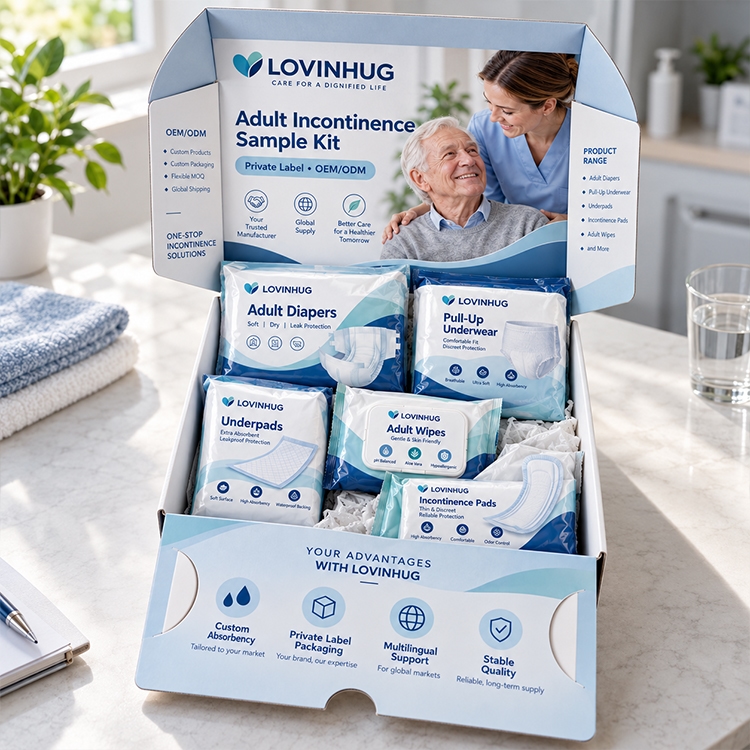
LOVINHUG focuses on customized bulk wholesale and OEM/ODM for adult incontinence lines—built for distributors, importers, care facilities, and private labels.
Flexible MOQ and 7–30 day delivery window
If you’re doing reorders, speed matters. Your supply chain can’t be “maybe next month.” LOVINHUG is set up for flexible MOQ and a fast 7–30 day delivery window (depending on SKU and packaging complexity).
Free samples and private-label support
Free samples help you stop guessing. You can test:
day vs night usage
fit across sizes
tab strength and re-fastening
material feel for sensitive users
And yes, private label is supported—because packaging is half the fight in this industry.
Product Keywords and Internal Links
If you’re building a line, these are the common SKU families buyers ask for: