What a Full Elastic Waist Adds to Adult Diaper Fit Stability
Fit fails quietly.
An adult diaper can carry a large absorbency claim, use a high loading of sodium polyacrylate SAP, and look perfectly secure immediately after application, yet begin sliding, twisting, or opening at the legs once the wearer sits, walks, transfers, or turns in bed.
So why do buyers still treat the waistband as a comfort feature?
A full elastic waist is part of the product’s load-bearing structure. Its job is not merely to make the brief feel soft or underwear-like. It must hold the chassis against the waist and hips, keep the absorbent core centered, preserve leg-cuff contact, and recover after repeated body movement.
That is what adult diaper fit stability really means: the product remains in its intended position without excessive sagging, rolling, twisting, pressure, or gap formation during the expected wear period.
My blunt view is that many supposedly high-absorbency products fail because the waistband gives up before the absorbent core does.
Table of Contents
A Full Elastic Waist Is a Mechanical System, Not a Decorative Panel
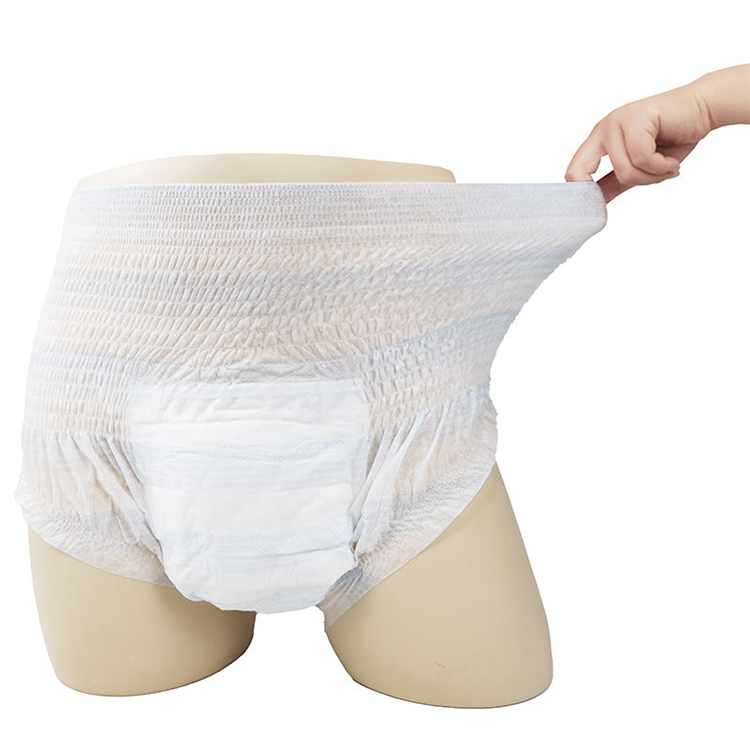
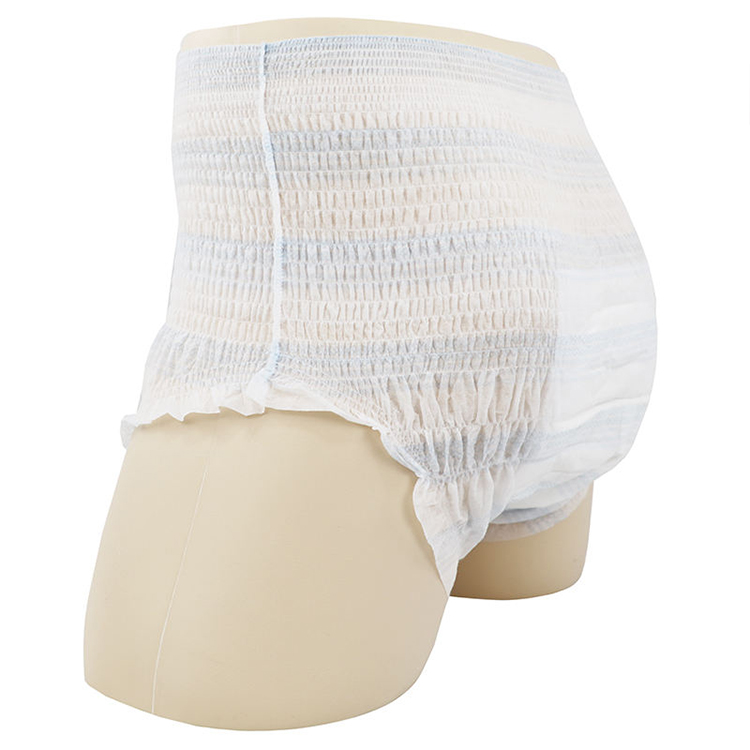
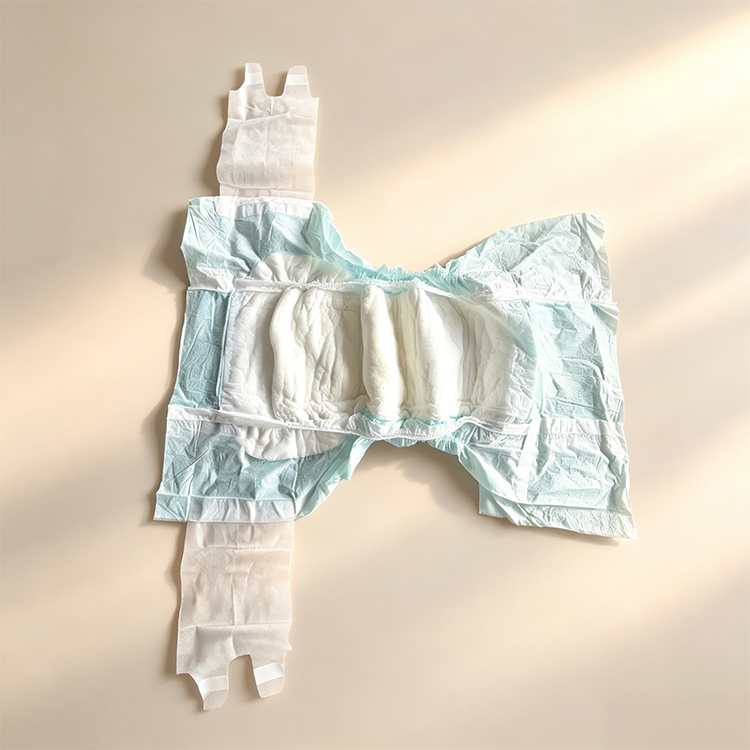
In sourcing language, a full elastic waist usually means that stretchable material extends around most or all of the waist circumference rather than being limited to one narrow rear strip, two side ears, or several small elastic zones.
The terminology is not completely standardized. One supplier may describe a product as having a “360° elastic waist,” while another uses “full elastic waistband,” “all-around stretch,” or “elasticated waist panel.” Buyers should therefore inspect the construction instead of accepting the marketing phrase.
The technical function is clearer. The EDANA adult incontinence product component guide defines the waistband as a component that provides or improves fit around the waist. The same guide identifies elastic containment flaps and leg gatherers as components that improve fit and help prevent leakage.
These parts must work together.
A full elastic waist cannot replace leak guards. It cannot compensate for a slow acquisition-distribution layer. And it cannot make the wrong size fit correctly. What it can do is maintain the geometry that allows those other components to perform.
What a Full Elastic Waist Actually Adds to Adult Diaper Fit
A full elastic waist contributes to adult diaper fit through tension distribution, elastic recovery, chassis stabilization, and better control of the changing distance between the waist, abdomen, hips, and leg openings.
It Distributes Holding Force Across a Wider Area
A localized elastic strip concentrates force in a narrow zone. That can hold the rear panel temporarily, but it may not control movement at the sides or front.
A full elastic waist spreads tension around a larger circumference. Instead of one panel doing all the work, multiple elastic zones share the load.
This matters because adult bodies are not rigid cylinders. The abdomen may project farther than the natural waist. The hips may be wider. Soft tissue moves when the wearer sits. A wheelchair user may remain in hip flexion for hours. A bedbound user may place most pressure on one side.
Wider force distribution can reduce two opposing failures:
A loose waist that allows sagging and gap formation
A narrow, over-tight band that rolls or leaves concentrated pressure marks
But “more tension” is not the answer. Balanced tension is.
It Improves Elastic Recovery After Movement
Stretch is only half the waistband story.
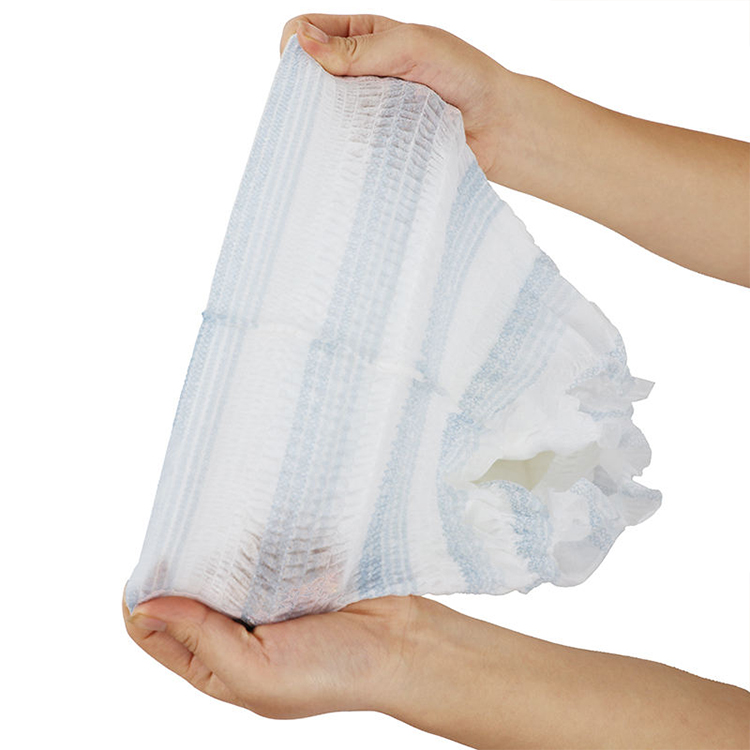
Recovery is the ability of the elastic structure to return toward its previous dimension after it has been extended. A waistband may feel strong during the first fitting but gradually lose holding force after several hours of walking, sitting, heat exposure, toileting, or repeated pull-down and pull-up cycles.
That permanent or semi-permanent deformation is often described as elastic set, force decay, relaxation, or creep, depending on the test method and material system.
A secure fit adult diaper needs enough recovery to follow the body after movement. When the wearer stands after sitting, the waistband should contract rather than remaining stretched in the seated-body shape.
Cheap elastic often fails here.
The product still covers the body, but the chassis sits 20–40 mm lower, the core begins hanging away from the crotch, and the thigh openings become visibly larger. The complaint later arrives as “poor absorbency,” even though the original failure was loss of waist recovery.
It Keeps the Absorbent Core Centered
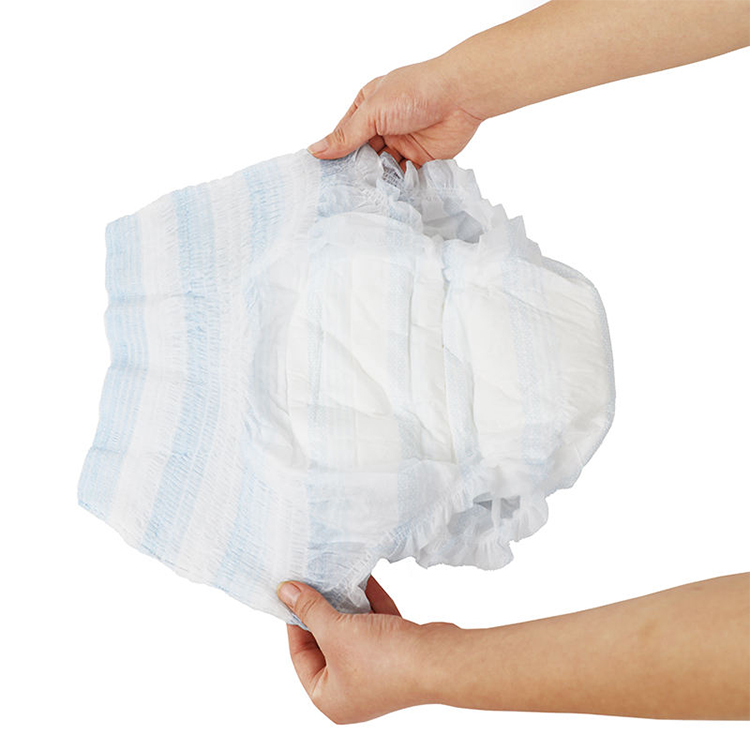
The absorbent core is usually built from cellulose fluff pulp, superabsorbent polymer, or a combination of both. Sodium polyacrylate, commonly represented as (C₃H₃NaO₂)n, can retain large amounts of fluid, but the swollen core becomes heavier and may change shape during wear.
Gravity wins eventually.
A full elastic waist helps carry that increasing load and limits downward core migration. This is especially important in high-absorbency and overnight briefs, where the wet product may weigh several hundred grams more than it did when dry.
Research has also treated sagging as a distinct engineering problem. A 2022 study indexed by PubMed proposed an origami-inspired adult diaper system designed to reduce sag and increase wicking across the pad. The design was different from a conventional elastic waistband, but the study makes an important point: absorbency, shape retention, liquid distribution, and discretion are connected engineering variables.
A core that sags is no longer sitting where the design team intended.
It Protects Leg-Cuff and Leak-Guard Geometry
The waist and legs are mechanically linked.
When a loose waistband lets the product slide downward, the leg openings move away from the groin. Standing leak guards may fold, flatten, or shift outward. A side channel then opens even though the core still has unused capacity.
A waistband does not directly absorb urine. It protects the alignment of the parts that do.
Full Elastic, Partial Elastic, and Tab Briefs Compared
No single waistband structure is automatically best. The right choice depends on mobility, care workflow, body shape, leakage volume, change method, and target retail price.
Design
Main Fit Mechanism
Fit-Stability Strength
Common Failure
Best-Fit Use Case
Full 360° elastic waist
Circumferential stretch and recovery
Holds the chassis close during walking, bending, and independent toileting
Force decay, rolling, torn side seams, excessive pressure
Mobile or semi-mobile adults using pull-up underwear
Partial rear elastic
Localized stretch at the back waist
Improves rear contact without adding a fully elastic chassis
Front panel drift and weaker side control
Economy briefs and moderate movement
Elastic side ears
Stretchable side panels combined with fastening tabs
Allows adjustable tension across different body shapes
Ear overstretch, uneven tab angle, weak recovery
Tab-style briefs for assisted care
Fixed chassis with tabs
Tabs provide most of the adjustment
High caregiver control when correctly fitted
Local pressure, loose rear waist, uneven fastening
Bedbound users and frequent in-bed changes
Full elastic plus refastenable tabs
Circumferential support with adjustable closure
Strong control of waist, hips, and repeated checks
Higher material cost and more complex manufacturing
Heavy incontinence, overnight use, institutional care
I would not choose between these structures from a product photograph.
I would test them under movement and wet loading.
The Four Moments That Expose a Weak Adult Diaper Waistband
A waistband can look excellent on a flat table and still fail on a person. Four moments usually expose the truth.
Sitting Down
When a wearer sits, the hip angle closes and the abdomen changes shape. Soft tissue may push forward or fold over the front waist panel.
A weak waistband remains stretched after this movement. An excessively tight waistband may roll downward, distort the front panel, or pull the leg openings upward.
The correct design follows the abdominal change without cutting, folding, or losing contact.
Standing Up
Standing reverses the seated geometry.
The waist becomes narrower for many wearers, and a waistband with poor recovery may remain loose. This is when the diaper begins to slip.
A useful fit test is not simply whether the product stays up. It is whether the waist, core, and leg openings return to their original positions after five or ten sit-to-stand cycles.
Bed-to-Chair Transfers
Transfers apply diagonal force.
A caregiver may pull clothing upward, support one hip, rotate the torso, or slide the wearer across a transfer board. One side of the diaper can be stretched much harder than the other.
If the waistband and tabs cannot redistribute that load, one side loosens first. The result is often a one-sided rear or thigh leak several hours later.
Fluid Loading and Core Swelling
The dry fit is only the starting point.
As SAP absorbs liquid, the core becomes heavier and thicker. Poorly distributed fluid may create one swollen zone that pulls the chassis downward or pushes the leg cuffs away from the body.
Full Elastic Waist Adult Diapers and Leakage Control
A stable waist can reduce leakage risk, but buyers should not turn that statement into a false “leak-proof” promise.
Leakage is caused by a chain of possible failures:
Incorrect size or body-shape match
Slow topsheet strike-through
Poor acquisition-distribution performance
Collapsed standing leak guards
Loose or over-tight leg openings
Core bunching or breakage
Rewet under body pressure
Waistband drift
Wrong product format for the user
Excessive wear time
The waistband influences several of these factors, especially drift, cuff position, and core stability. It does not control all of them.
The CDC’s Prevalence of Incontinence Among Older Americans report found that 50.9% of noninstitutionalized people aged 65 and older reported urinary leakage and/or accidental bowel leakage in the 2007–2010 NHANES data. Urinary leakage alone was reported by 43.8%.
Those numbers are old, but they remain useful for scale. Adult incontinence product performance is not a minor packaging issue. A fit defect can affect a large population and create additional work for families, hospitals, nursing homes, home-care agencies, and distributors.
And leakage is not limited to wet clothing.
Repeated moisture exposure can contribute to incontinence-associated dermatitis. A loose waistband that repeatedly opens a leak path can therefore become part of a broader skin-care failure, although no serious manufacturer should claim that a waistband alone prevents dermatitis.
The Hard Truth: Too Much Elastic Can Make Fit Worse
There is a point where stronger becomes worse.
An over-tensioned waistband may:
Roll into a narrow cord
Leave red marks around the abdomen
Compress soft tissue unevenly
Pull the front rise too high
Distort the absorbent core
Lift the leg cuffs out of their intended position
Make independent pull-down difficult
Tear side seams during application
Cause users to choose an oversized product for comfort
That last failure is common.
A wearer finds the correct size uncomfortable, moves to the next size up, and accidentally creates large leg gaps. The brand then receives leakage complaints that appear unrelated to waistband pressure.
I would rather specify a wider, well-distributed elastic zone with controlled recovery than a narrow waistband with aggressive force.
Comfort and leakage control are not enemies. Poorly distributed force makes them enemies.
How Buyers Should Test Adult Diaper Fit Stability
A hand-stretch demonstration is not a waistband test.
For an OEM, private-label, hospital, distributor, or pharmacy program, I would build the approval process around measurable deformation and real-use simulation.
Record the Actual Construction
Ask the supplier to identify:
Number and position of elastic strands
Elastic material type
Elastic-zone width
Front, rear, and side-panel construction
Relaxed waist circumference
Maximum intended extension
Recommended wearer waist and hip range
Side-seam bonding method
Elastic-ear basis weight and laminate structure
Adhesive application pattern
A vague answer such as “strong Lycra” is not a specification.
Test Extension Force at Multiple Points
Measure force across the intended stretch range rather than reporting one maximum number.
The most informative curve shows how much force is required at increasing extension and whether the force rises smoothly. Sudden force spikes can create pressure points. Very low force at the upper end can signal weak support for larger users.
There is no universal force target that fits every size and chassis. A medium pull-up, a 3XL bariatric brief, and a tab-style institutional product should not share one elastic requirement.
Measure Recovery and Force Decay
Stretch the waistband to a defined percentage and hold it for a controlled period, such as 30 minutes, two hours, or four hours. Then release it and record:
Permanent set
Circumference recovery
Remaining holding force
Visible waviness
Delamination
Elastic breakage
Side-seam damage
Repeat the test after heat and humidity conditioning when products will be shipped through hot warehouses or tropical markets.
Run a Wet-Load Movement Test
Dose the product with 0.9% saline solution, allow the core to distribute and swell, and then test it on an appropriate mannequin, fixture, or wear panel.
Include:
Repeated sit-to-stand movement
Walking
Side bending
Bed turning
Wheelchair sitting
Pull-down and pull-up cycles
Caregiver refastening
Four-hour or overnight-equivalent load conditions
Then inspect waistband height, core position, thigh gaps, leak-guard position, seam damage, and permanent deformation.
The test is harsher than a showroom demonstration.
It should be.
Compare the Largest and Smallest Users in Each Size
A waistband must support the lower end of the size range without looseness and the upper end without excessive pressure.
Do not test only the middle.
Also measure both waist and hip circumference. Selecting a product only by waist size can fail users whose hip or abdominal profile is the larger measurement.
Why Fit Stability Matters to Institutional and Medicaid Buyers
Adult incontinence supplies can be medically necessary, not merely convenient.
In 2024, Florida expanded Medicaid coverage for medically necessary adult incontinence supplies following litigation over the state’s previous age-based exclusion. Disability Rights Florida’s coverage announcement lists adult diapers, disposable briefs, protective underwear, pull-ons, liners, shields, guards, pads, and related undergarments among the covered supply types.
That case does not prove that a full elastic waist prevents skin breakdown or infection. It does show that adult incontinence supplies may form part of medically necessary community care.
This raises the standard buyers should apply.
When a product is used by a person with severe mobility limitations, neurological impairment, bowel incontinence, or dependence on caregivers, “good enough” fit may mean additional linen changes, disturbed sleep, more staff time, or avoidable skin exposure.
Procurement teams should therefore evaluate fit stability as a performance metric, not an aesthetic preference.
What I Would Specify for a Secure-Fit Adult Diaper
For mobile users, I would start with a full elastic pull-up chassis that combines:
Wide 360° elastic distribution
Controlled extension force
Strong recovery after repeated toileting
Tear-away side seams that do not rupture prematurely
Stable leg openings
Upright inner leak guards
Fast liquid intake
Low rewet under pressure
Core integrity after walking and sitting
For assisted or bedbound users, I would usually prioritize:
Elastic front and rear waist support
Refastenable tabs
Wide landing zone
Elastic side ears where appropriate
High back coverage
Strong standing leak guards
Stable core under side pressure
Easy size adjustment during in-bed application
The choice between pull-up and tab brief should follow the user’s mobility and care workflow, not the buyer’s preference for a more attractive product format.
For private-label development, the waistband should also be locked into the golden-sample and change-control process. A silent substitution in elastic supplier, adhesive, strand count, side-panel nonwoven, or bonding temperature can alter fit even when the finished product looks almost identical.
A serious adult diaper OEM/ODM program should therefore connect waistband specifications to production-line settings, batch testing, size grading, packaging compression, and complaint tracking.
FAQs
How does a full elastic waist improve adult diaper fit?
A full elastic waist improves adult diaper fit by distributing holding force around most or all of the waist, following changes in body shape, limiting downward chassis movement, keeping the absorbent core centered, and helping leg cuffs and standing leak guards remain correctly positioned during walking, sitting, transfers, toileting, and bed turning.
Its value comes from recovery, not stretch alone. A waistband that extends easily but remains permanently enlarged after several hours will eventually allow sagging and thigh gaps.
Is a full elastic waist better than a partial elastic waistband?
A full elastic waist is generally better for circumferential fit stability because it controls the front, sides, and rear of the product, while a partial waistband concentrates stretch in one area; however, actual performance depends on elastic force, recovery, panel construction, body shape, sizing, leg-cuff design, and the wearer’s mobility.
A well-engineered partial design may outperform a cheap 360° waistband. Buyers should compare movement tests and force-decay data rather than relying on the construction name.
Can a full elastic waist stop adult diaper leakage?
A full elastic waist can reduce some adult diaper leakage by limiting waist drift, keeping the core centered, maintaining closer leg contact, and protecting leak-guard alignment, but it cannot stop leaks caused by wrong sizing, slow fluid intake, collapsed cuffs, excessive rewet, core breakage, heavy output, or an unsuitable product format.
Treat the waist as one part of the seal system. Leak protection depends on the waistband, cuffs, guards, topsheet, acquisition layer, absorbent core, backsheet, and application method working together.
What is the best adult diaper for a secure fit?
The best adult diaper for a secure fit is a correctly sized product whose waistband maintains balanced tension and recovery while its leg cuffs, leak guards, core position, and closure system remain stable during the user’s real movements, expected fluid load, change routine, body shape, and daytime or overnight wear period.
Mobile users often benefit from 360° pull-up underwear. Bedbound or caregiver-assisted users frequently need adjustable tab-style briefs with elastic waist support.
How should a full elastic waist adult diaper be tested?
A full elastic waist adult diaper should be tested for relaxed and extended circumference, force across the usable stretch range, recovery after prolonged extension, permanent set, force decay, seam strength, repeated pull-down cycles, wet-load sagging, core movement, cuff alignment, pressure marks, and leakage during sitting, walking, transfers, and bed turning.
Testing only the dry product misses the hardest conditions. The waistband should be evaluated after the absorbent core has taken repeated doses and become heavier.
Does stronger waist elastic always provide better stability?
Stronger waist elastic does not always provide better stability because excessive force can roll the waistband, create pressure marks, distort the absorbent core, pull leg cuffs out of position, make toileting difficult, and push users toward an oversized diaper that produces larger waist or thigh gaps and greater leakage risk.
The target is controlled, distributed tension with good recovery. Maximum force is a poor substitute for balanced chassis engineering.
Your Next Step: Test the Waist Before Approving the Absorbency Claim
Stop approving adult diapers from flat samples.
Stretch the waistband. Hold it. Release it. Load the core with 0.9% saline. Repeat the sit-to-stand cycle. Check the rear waist after wheelchair sitting. Inspect the cuffs after side turning. Measure the permanent set rather than trusting your hand.
And compare the fit at both ends of the stated size range.
For distributors, hospitals, care facilities, and private-label brands, request the exact waistband construction, recovery test, wet-load fit results, side-seam data, and production-batch tolerances before committing to a bulk order.
A full elastic waist will not rescue weak absorbency engineering.
But when it is properly designed, it keeps the entire adult diaper system working where it belongs: close to the body, centered under load, and stable through real movement.