How Front and Rear Waist Elastic Change Adult Diaper Fit
Front and rear waist elastic change adult diaper fit by controlling three things: how holding force is spread around the torso, how far the chassis drifts downward once the core is loaded, and whether the leg openings stay against the body during sitting, walking and turning. The rear waist mainly resists sag and keeps back coverage in place. The front waist has to follow a changing abdomen without rolling or cutting in. Elastic strength alone does not decide the outcome. Placement, width, recovery after stretch and bonding method all contribute. For procurement and product teams, the useful question is not whether a brief has an “elastic waist.” It is which parts of the waist are elasticated, how that elastic behaves after hours of wear, and whether the configuration suits the wearer’s mobility and care routine.
What Do Front and Rear Waist Elastic Actually Do?
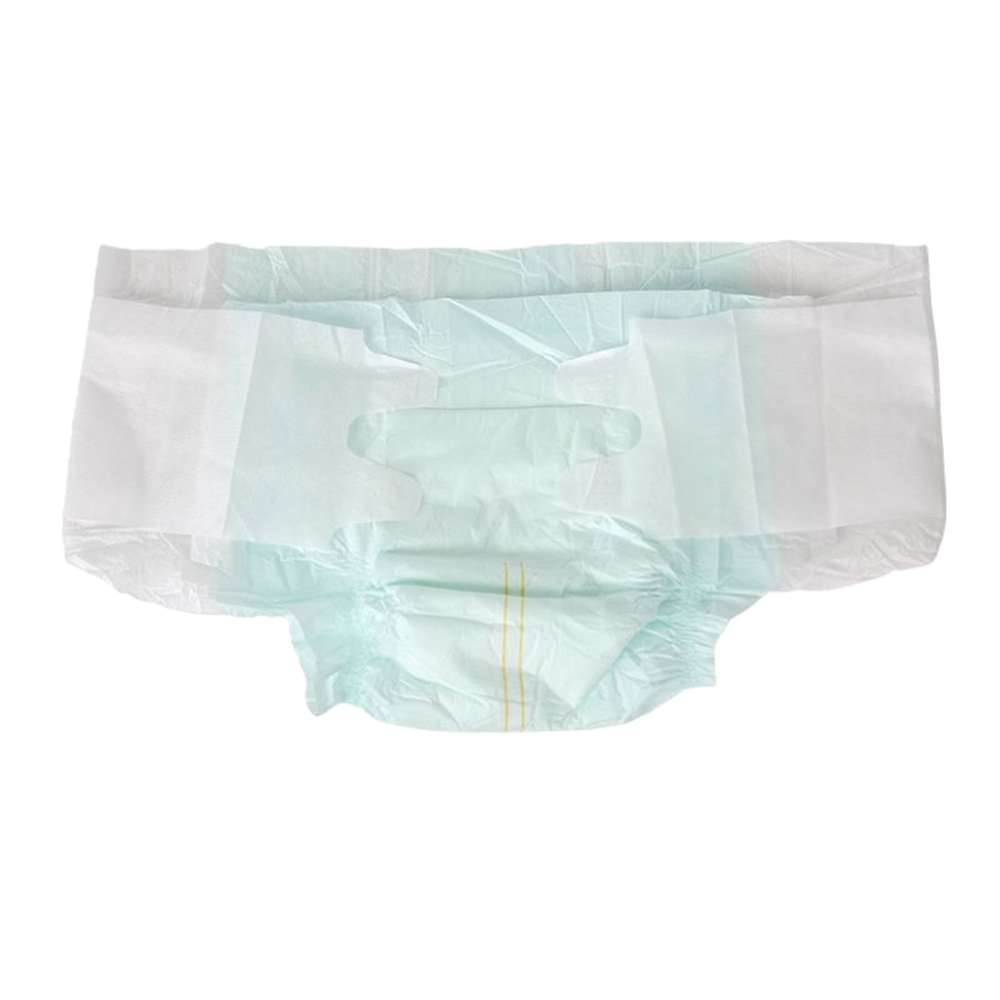
In an adult diaper, the waist elastic is a stretchable component at the front and/or rear waist edges that holds the chassis against the body. It is usually a laminate rather than a bare band. A USPTO patent publication on front and back waist panels describes waistbands supplied either as a single elastic film or as an elastic laminate in which film or strands are bonded to nonwoven. In some assembly processes the elastic is attached while stretched, so the carrier web gathers into corrugations when it relaxes. The patent covers absorbent articles such as diapers generally, not adult products specifically, but the construction principle carries across to adult briefs and pull-ups.
The front and rear zones do different mechanical work. The following is design reasoning to confirm in testing, not a universal rule:
Rear waist elastic resists the downward pull of a loading core and keeps the back panel high enough to cover the buttocks. Without it, the rear edge drops first and the whole chassis follows.
Front waist elastic has to accommodate the abdomen, which can change shape between standing and sitting. Too little holding force leaves the front panel loose. Too much makes it fold or roll.
Both together keep the crotch region positioned between the legs, which in turn keeps the leg cuffs aligned with the thigh crease.
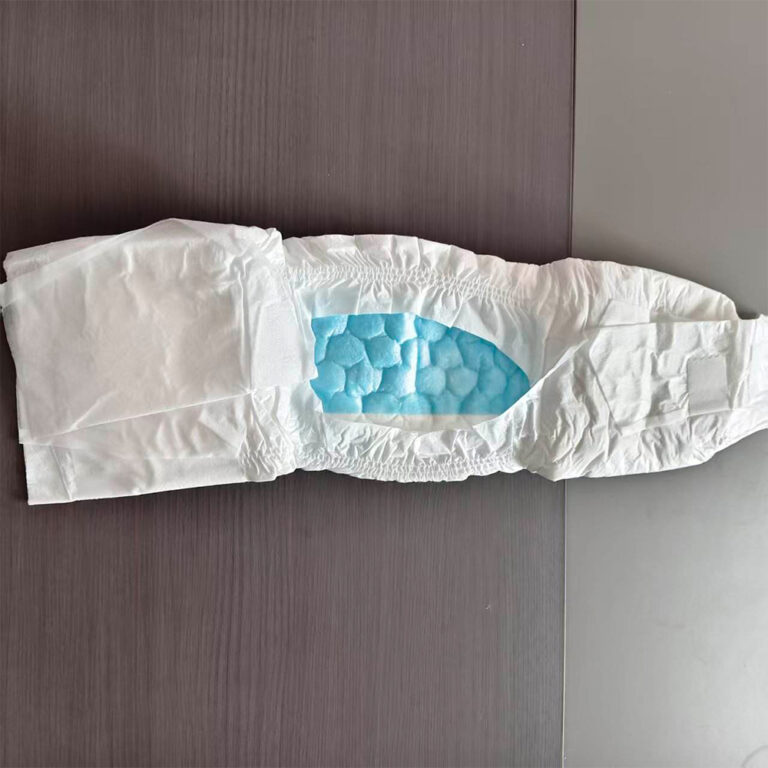
Some suppliers describe a product as having a full or 360° elastic waist, others as having separate front and rear elastic panels. The terminology is not standardized, so buyers should inspect the construction. The manufacturer’s article on what a full elastic waist adds to adult diaper fit stability covers the full-circumference case in more depth.
How Front and Rear Waist Elastic Affect Fit Differently
Rear waist: sag resistance and back coverage
When urine enters the core, the product gets heavier and pulls downward. The rear waist is the main anchor against that pull, because the back panel’s upper edge is the point from which the loaded chassis hangs.
A USPTO patent publication on waist elastic load loss states the failure sequence plainly: if elastic portions stretch further during wear, the waistband becomes more relaxed, which may lead to sagging, leaking or pulling away from the wearer. The same document describes a four-hour hold stress relaxation test as one way to quantify in-product load loss. It is a patent disclosure about a specific fastening design, not an industry standard, and the load-loss figure in its claims should not be treated as a buying threshold. What buyers can take from it is the principle: how much holding force remains after hours under stretch matters more than the force at first fitting.
Front waist: abdomen shape and seated posture
The front waist faces a different problem. Abdominal circumference can exceed natural waist circumference, and sitting changes the shape again. A front elastic that is too weak lets the top edge fold away from the body. One that is too strong tends to roll the edge into a cord, leave pressure marks, or pull the front rise upward.
The manufacturer’s guide to measuring waist, hip and rise makes a related point from the sizing side: measuring only the narrowest part of the torso can understate the abdominal circumference the front panel must cover.
Leg opening alignment
Waist drift opens leg gaps even when the leg elastics are adequate. When the chassis slides down, the leg openings move away from the groin and standing leak guards can flatten or shift. That is why the manufacturer’s analysis of how leak guards, leg cuffs and waist design reduce side leakage treats the waist as part of a single seal system. A waist that holds position does not stop leakage by itself. It protects the geometry that the cuffs and guards depend on.
Which Waist Elastic Configuration Suits Which Product?
No configuration is best in every case. The table below compares common structures by mechanism and risk. It is qualitative: it describes typical trade-offs, not measured performance, and any real product can differ.
Configuration
How it controls fit
Main advantage
Main risk
What to verify with the supplier
Rear waist elastic only
Anchors the back panel against sag
Lower material cost; simpler construction
Front panel drift; weaker side control
Front-panel behavior when seated; size-boundary fit
Separate front and rear waist elastic
Two elastic zones, each sized for its panel
Can be tuned per panel; better front-and-back control
Mismatched force between panels; extra components
Elastic width, strand or film type, and force of each zone
Front and rear with different stretch
Rear and front panels deliberately given different stretch
Fit tuned to abdomen versus lower back
More complex specification and change control
Whether the difference is intentional and documented
Full 360° elastic waist (pull-up)
Circumferential tension and recovery
Underwear-like fit; independent toileting
Rolling, excess pressure, side-seam stress
Recovery after repeated pull-down; side-seam strength
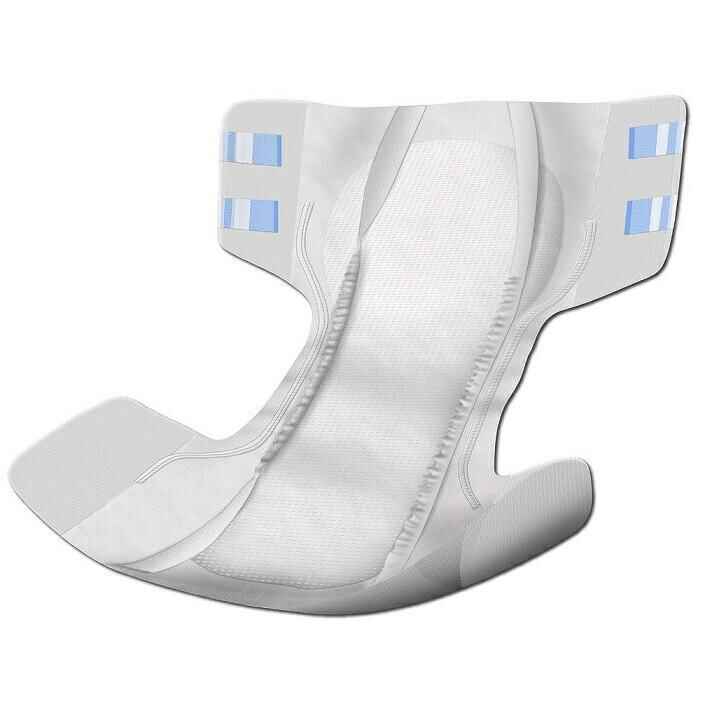
Elastic side panels plus tabs (tab brief)
Adjustable tension at closure
Caregiver can fine-tune fit; suits assisted care
Uneven tab angle; overstretched panels
Tab placement, refasten cycles, panel recovery
The patent publication on front and back waist panels with different stretch characteristics notes that making front and rear bands from different pre-made materials adds manufacturing cost and complexity. That is a reminder that waist configuration is a cost decision as well as a fit decision, and that a quoted price difference may reflect real construction differences rather than margin.
Why Recovery Matters More Than Peak Tension
Waist elastic can feel strong in a hand test and still fail after a few hours. Two properties are easy to confuse:
Extension force is how hard the elastic pulls back at a given stretch.
Recovery is how well it returns toward its original dimension after being held stretched. Related terms include permanent set, stress relaxation and force decay.
A waist that loses holding force while the core is also growing heavier produces a double failure: less support against more load. Complaints then arrive as “poor absorbency” even though the origin was the waist.
Illustrative scenario (not a customer case): a distributor receives complaints that a pull-up slides down at the back by afternoon. The core and leg cuffs are unchanged from the previous batch. The difference is a substituted rear-waist elastic laminate that feels equally tight when stretched by hand but relaxes more under sustained stretch. A hand test would not have caught it. A held-stretch test would.
For buyers, the practical request is a force-versus-extension curve plus a held-stretch recovery result, measured on the finished product rather than on loose elastic. No universal target exists, because a medium pull-up, a bariatric tab brief and a tab-style institutional brief have different needs. The aim is consistency between approved samples and production batches, and acceptable behavior at both ends of each size range.
When More Waist Elastic Makes Fit Worse
The conventional assumption is that tighter, wider and more elastic is always safer. It is not. Excess waist tension can:
roll a narrow band into a cord;
compress soft tissue and leave marks;
pull the leg cuffs out of position;
push wearers or caregivers up to the next size for comfort, which creates leg gaps;
add a visible edge under clothing.
The discretion trade-off is real. The manufacturer’s article on how pull-up fit affects discretion under clothing notes that narrow waistbands may roll while wide bands can show as a belt-like band, so there is no single “right” waist width for every wearer and garment. A defensible position is that distributed, well-recovering tension beats high peak force. That holds when comfort, skin condition and consistent size use matter. It does not hold in every case: a user with high mobility and heavy output, for example, may need firmer rear support than a seated user with light leakage.
How Materials and Construction Change Waist Elastic Performance
Several variables sit behind the label “elastic waist”:
Elastic form: film or strands, and the nonwoven they are laminated to. Each deforms and recovers differently.
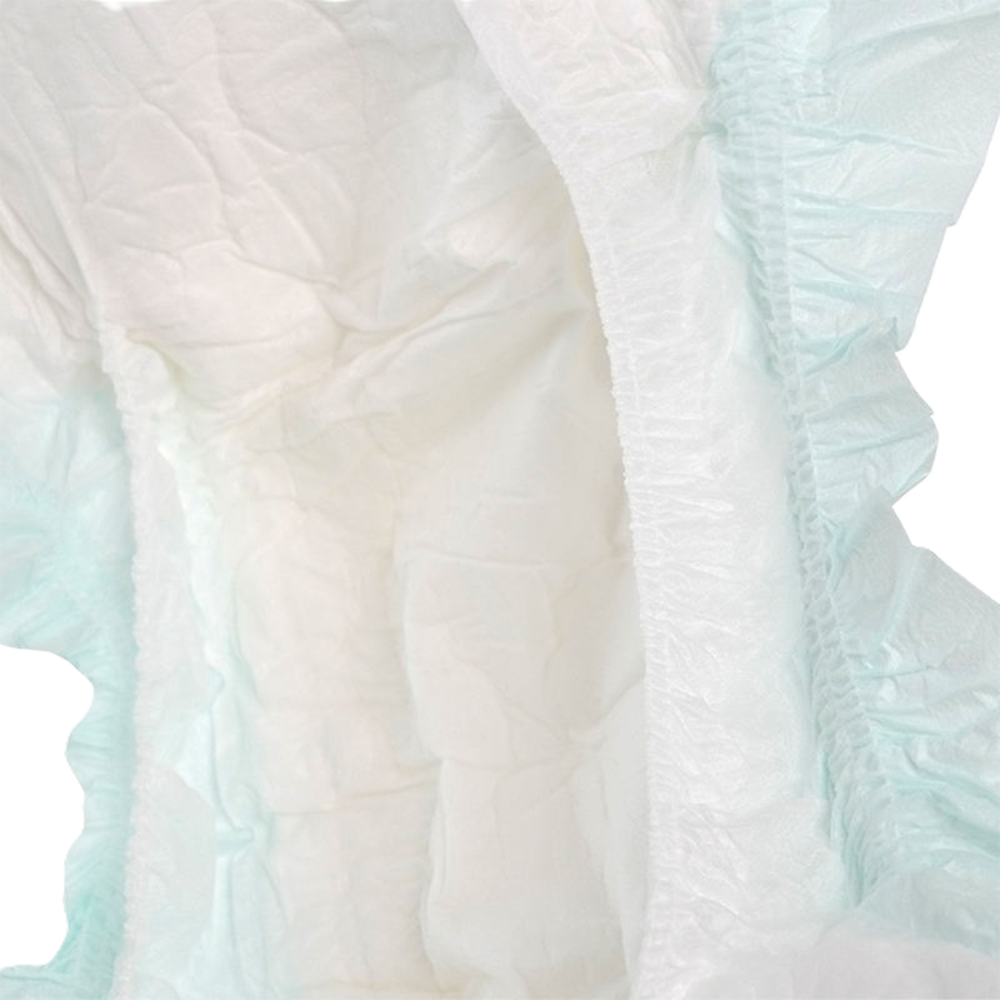
Zone width and strand count: wider zones spread force, but add bulk and may change breathability.
Bonding: elasticized waistbands are often separate components joined to the chassis. A USPTO patent publication on waist gasketing notes that bond strength often works against softness and smooth edges, particularly where the waistband edge touches skin. Stronger bonding secures the elastic but can roughen the edge.
Adhesive and nonwoven substrate: these influence feel, noise and whether the laminate stays intact under repeated stretch.
Substitutions in any of these can alter fit even when the finished product looks the same. The manufacturer’s discussion of how material changes affect adult diaper performance lists waist recovery among the tests to request when tabs and waist materials change.
What Fit Symptoms Reveal About Waist Elastic
When a product is failing in the field, the pattern of failure points to likely causes. These are diagnostic starting points, not proof.
Observed symptom
Likely waist-related cause
What to check first
Back of brief sags by mid-day
Rear elastic loses force; rear panel too short
Held-stretch recovery; rise and back coverage
Waist rolls into a cord
Narrow band; excessive tension; stiff edge
Elastic width, force curve, edge construction
Front panel folds when seated
Weak front elastic; abdomen larger than size assumes
Abdominal measurement; front elastic force
Red marks around waist
Force concentrated in a narrow zone
Zone width; force at upper extension range
Leg gaps appear after loading
Chassis dropped; waist drift
Wet-load test; waist height before and after
One side loosens after transfers
Uneven stretch across sides or tabs
Side-panel recovery; tab angle
How to Match Waist Elastic to Size and Body Measurements
Waist elastic can only perform within its intended extension range. If the wearer sits outside that range, even good elastic fails.
Measure waist at the point where the product will sit, the fullest hip and the largest abdominal circumference, and use the larger of the relevant numbers. Then compare against a size chart that states waist and hip ranges separately. Wide combined sizes such as M/L leave more wearers between steps. For samples, test at both ends of each size range: the smallest wearer should not see looseness, and the largest should not see rolling or pressure marks.
Mobility also changes the answer. A mobile adult who pulls the product up and down repeatedly stresses the waist differently from a caregiver-assisted user in bed, which is why pull-up and tab formats usually need different elastic specifications.
How to Specify Front and Rear Waist Elastic Before Requesting a Quote
A quotation is only reliable when the waist is specified rather than described. Prepare the following:
Product format: pull-up, tab brief, or both.
Elastic configuration: rear only, front and rear, 360°, or side panels. State whether front and rear should differ.
Size range: waist, hip and rise per size, and overlap between sizes.
Absorbency band: heavier loading increases sag demands.
Appearance requirements: discretion under fitted clothing versus maximum security.
Test evidence expected: held-stretch recovery, wet-load fit, seam strength.
Change control: approval needed before any change to elastic supplier, laminate, strand count, adhesive or bonding settings.
Shipping and storage conditions: heat, humidity and long compression can affect elastic.
A supplier that can adjust front and rear elastic, leg cuff height and side panels independently gives buyers more room to tune fit. The manufacturer’s page on adult diaper ODM customization options lists front and back waist elastics among the customizable elements. Customization still has costs, so confirm minimum order quantity, tooling and sample lead time directly with the supplier instead of assuming them. Also avoid over-assorting: validate one hero size range before multiplying variants.
What Should You Verify Before Approving a Waist Design?
Before signing off a sample or a production order, work through this sequence:
Confirm the exact elastic configuration in writing, including front and rear.
Request force-versus-extension and held-stretch recovery data on finished product.
Test dry and wet, with sit-to-stand, walking and turning, at both ends of each size.
Inspect rolling, red marks, back-panel drop, leg gaps and seam damage.
Lock the golden sample and require notice before any material change.
Re-test the first production batch against the approved sample.
If the supplier can only describe the waist as “strong elastic,” treat that as missing information, not as reassurance.
Frequently Asked Questions
What does front and rear waist elastic do on an adult diaper?
Front and rear waist elastic hold the diaper chassis against the body. The rear elastic mainly resists sagging and keeps back coverage in place, while the front elastic follows the abdomen. Together they help keep leg openings and leak guards correctly positioned.
Is a full elastic waist better than front and rear elastic panels?
A full 360° waist spreads tension around the whole circumference and suits mobile wearers using pull-ups. Separate front and rear panels can be tuned per area and suit tab briefs. Performance depends on force, recovery, sizing and construction, not the label.
Why does an adult diaper sag at the back?
Back sag usually comes from rear elastic losing holding force, an unsuitable size, a rise that is too short, or a heavily loaded core pulling the chassis down. A held-stretch recovery test and a wet-load wear test help separate these causes.
Can waist elastic be too strong?
Yes. Excessive tension can roll the waistband, leave pressure marks, distort the core, pull leg cuffs out of position and push users into oversized products. Wider, evenly distributed elastic with good recovery usually works better than narrow, high-force elastic.
Do front and rear waist elastic need different stretch?
Not always, but they can benefit. The front must accommodate abdominal change while the rear resists sag. A patent publication on waist panels describes giving front and rear waistbands different stretch characteristics to improve fit, comfort and performance.
What should I ask a manufacturer about waist elastic?
Ask for the elastic configuration, material type, zone width, strand or film details, bonding method, force-versus-extension data, held-stretch recovery results, size-range fit evidence, and the supplier’s change-control process for elastic or adhesive substitutions.