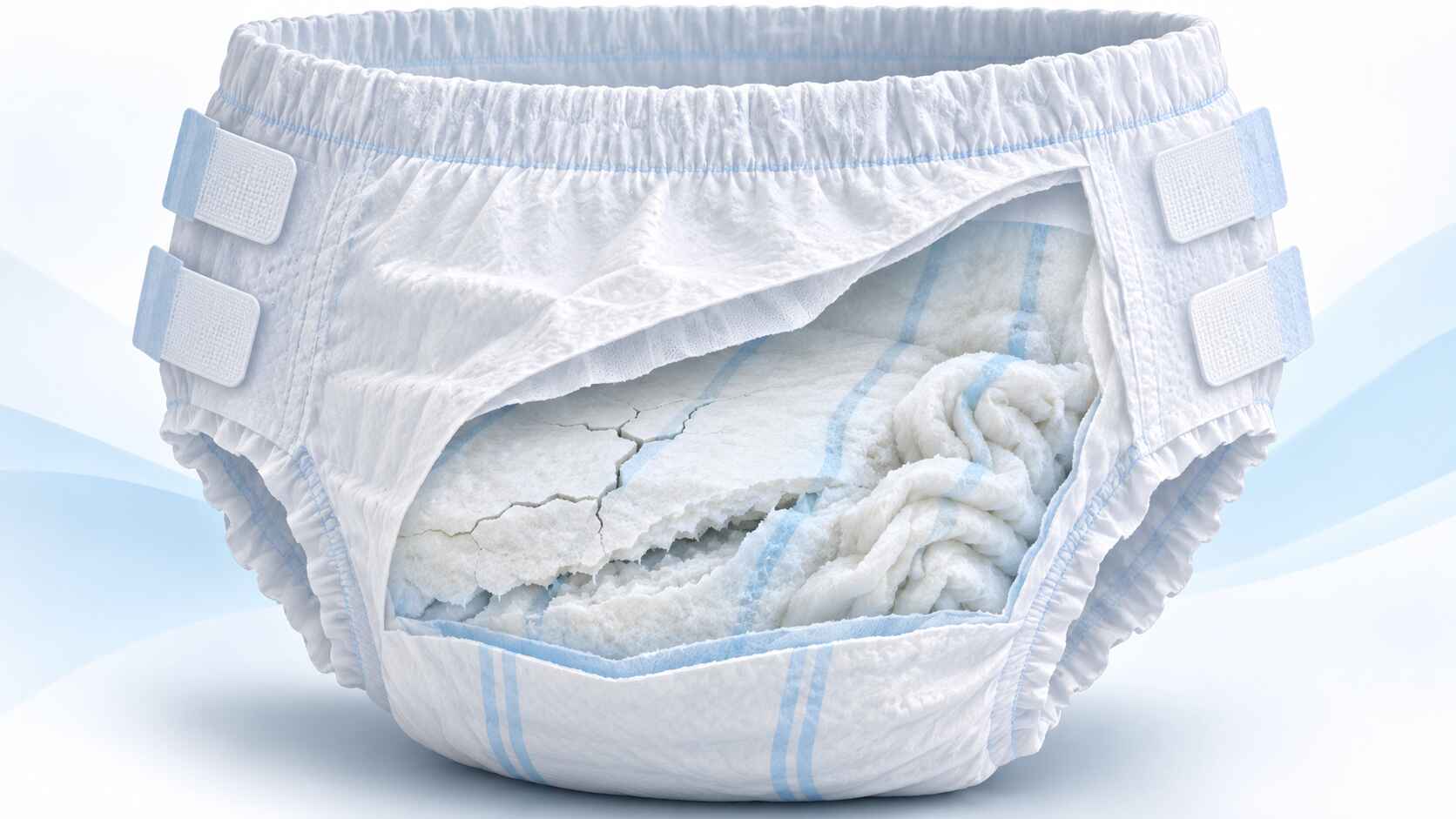
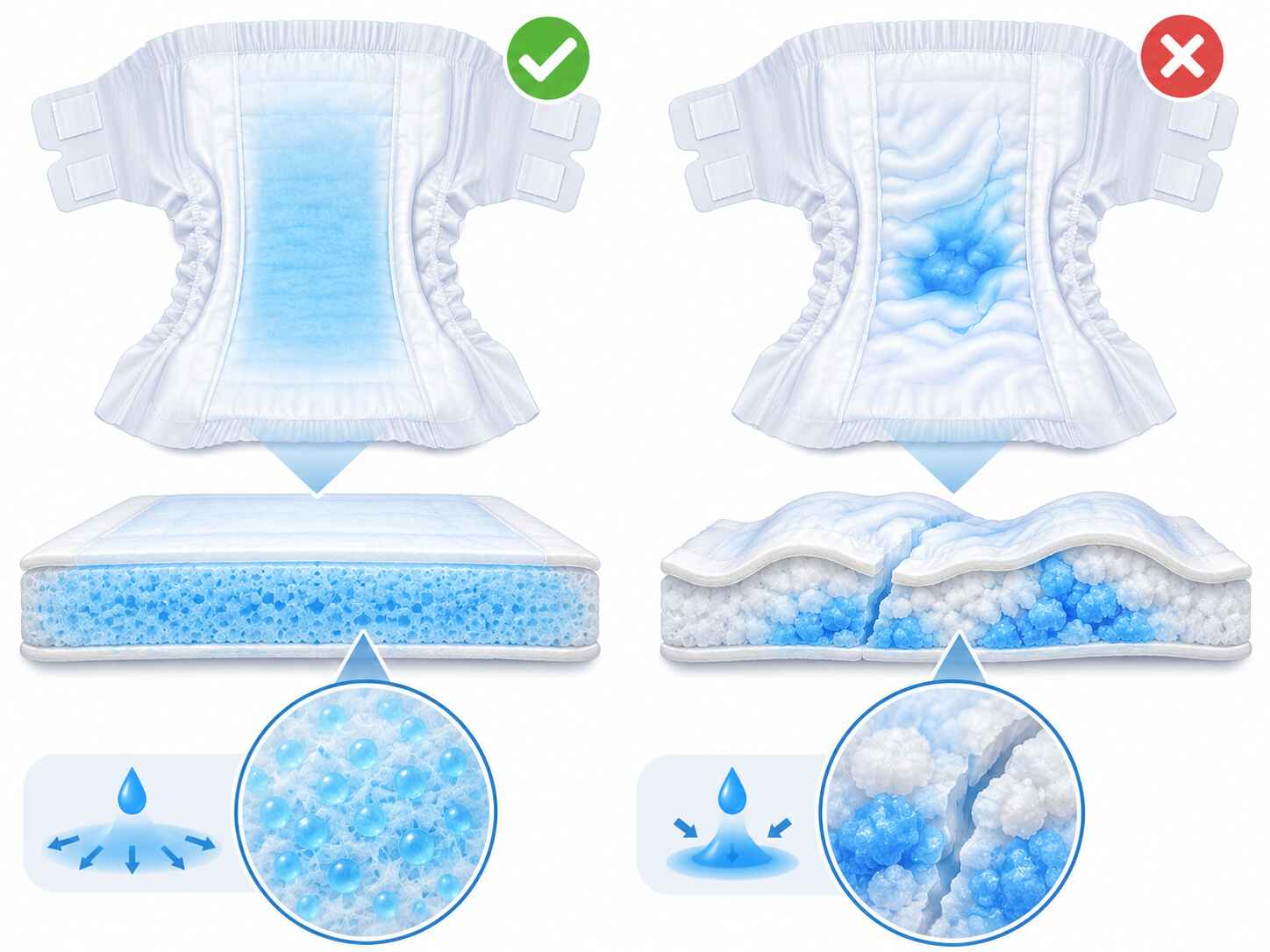
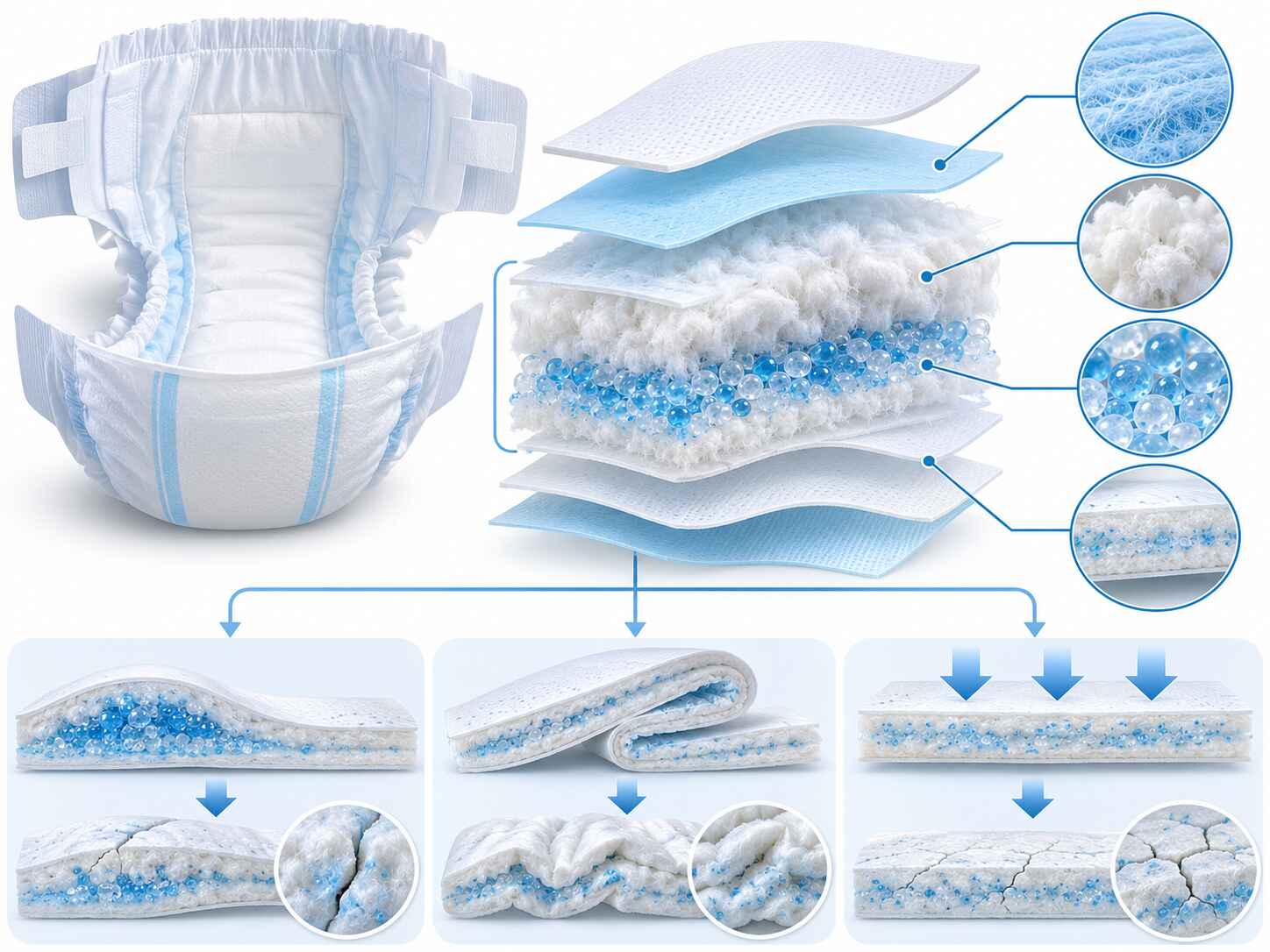
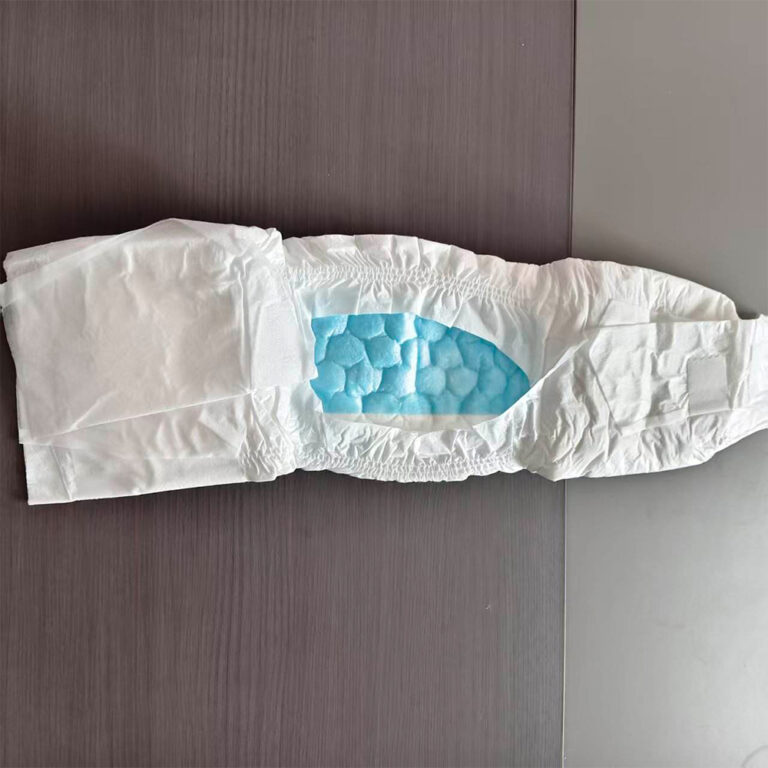
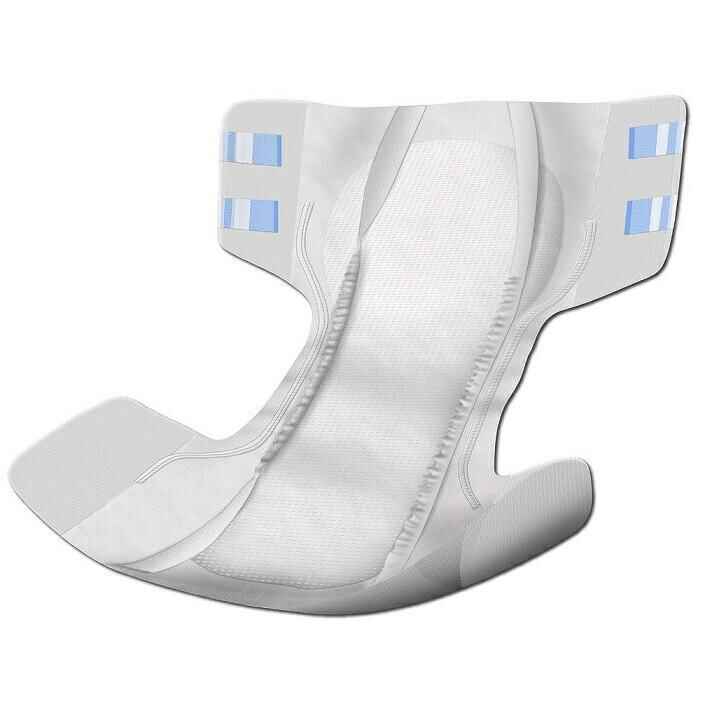
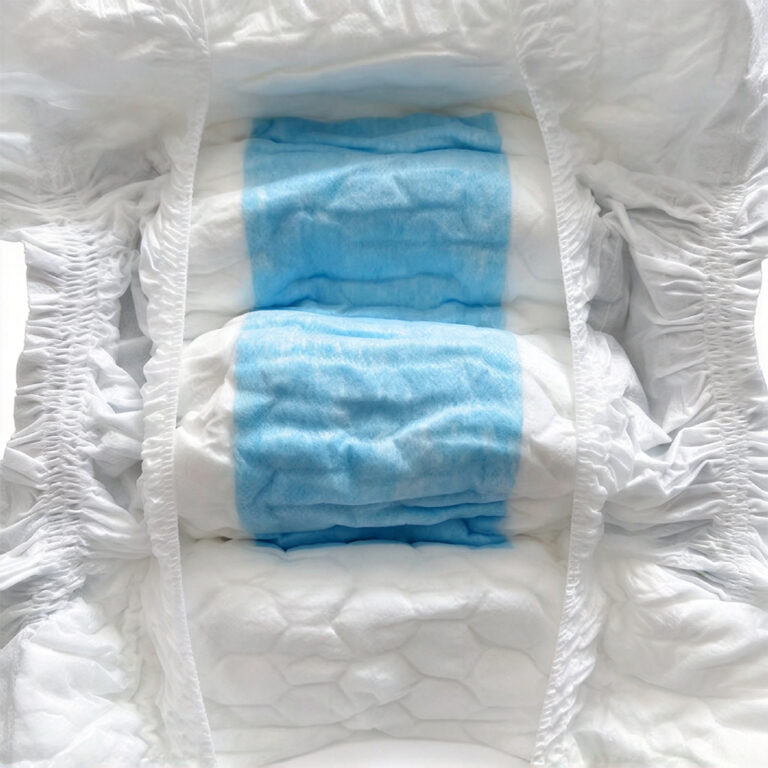
Absorbent core cracking and bunching happen when the fluff-and-SAP matrix inside an adult diaper loses its structural cohesion. The usual causes are a core with too little fluff or binding for its superabsorbent polymer (SAP) load, adhesive or core wrap that cannot hold the matrix once it is wet, compression and folding during packing, uneven core forming, and in-use stress such as sitting, turning, and repeated urination. Most of these are design and process decisions made long before the diaper reaches a user. That is why they show up as leakage complaints, a lumpy wet feel, and returns rather than as obvious factory defects. This article explains each cause, how to test for it, and what to write into a specification so a supplier can be held to it.
What Are Core Cracking and Bunching?
Core cracking is a fracture or separation in the absorbent core, often along the fold lines created when a diaper is packed. Bunching, also called roping, is the core narrowing into a hard or matted mass, typically in the crotch. Slumping is a related failure in which the wet core slips away from the chassis.
These terms have a documented technical meaning. US patent 5,833,678 describes cores that slump, crack, or rope during processing, storage, and use, and says the tendency increases as the core gets thinner. It grades bunching by comparing the core width of a used diaper with an unused one. The grades run from slight bunching, where the core starts to mat, to severe bunching, where it is hard and stiff. The patent is older and was written around disposable diapers generally. Treat it as a source of definitions and mechanisms, not of adult-diaper performance limits.
The consequence is practical. According to the same patent, breakage along the crotch fold line can leave the rear of the article largely unavailable for absorption, so leakage can occur once the front portion is saturated.
Failure mode
What the buyer sees
Likely structural cause
Quick check
Core cracking
Splits or gaps in the core, often at the crotch fold
Low fluff or binder for the SAP load, brittle or over-compressed core, packing stress
Wet the diaper, move it, cut it open, and inspect
Bunching / roping
Core narrows into a rope or hard mat
Wet matrix collapse, weak wrap or adhesive, side-to-side compression in use
Compare core width before and after use
Slumping
Wet core sags or slides off the chassis
Loss of adhesion between core and adjacent layers
Peel the layers apart wet and look at the bond
Gel blocking (related, but a fluid problem)
Surface wetness or leakage while parts of the core stay dry
SAP swells near the loading zone and blocks flow paths
Repeated-dose test, then section the core
Seven Root Causes Behind Core Cracking and Bunching
Less fluff, more SAP, thinner core
Fluff pulp does more than move liquid. It keeps SAP particles apart and in place. A white paper from adhesive supplier Bostik describes what happens as fluff is removed to make thinner products. Ratios move from roughly 50/50 SAP-to-fluff toward 60/40, 70/30, and beyond, and SAP can shift during wear once it is heavy with liquid. The same document says core cracking is not usually seen at 50/50. It becomes common at 70/30 if no adhesive is used, and at 80/20 adhesive is generally required both for production and for immobilising SAP.
Those ratios are an illustration from one supplier, not a pass/fail rule. The point for buyers is the direction of risk. When a supplier proposes a thinner core to cut freight volume or material cost, the stabilising job that fluff used to do has to be taken over by adhesive, wrap, or core geometry. The review of how material changes affect adult diaper performance covers why SAP, fluff, and adhesive changes should be assessed as a system.
Illustrative example (hypothetical, not a customer case): a night-use brief is redesigned from a fluff-rich core to a thinner, SAP-heavy one. It passes the dry-feel check and a single-dose capacity test. After pallet storage and a day of wheelchair use, the wet core ropes into a narrow band at the crotch. The capacity number was correct. It simply did not measure whether the matrix could hold together.
Adhesive and core wrap that do not match the core
Adhesive is a structural component, not a finishing detail. Bostik lists its roles in a traditional core: helping prevent core shifting, holding the acquisition-distribution layer in place, stabilising the fluff/SAP matrix, sealing the core wrap, and bonding materials to prevent shifting.
Three variables matter:
Wet strength. The patent notes that high wet strength adhesives tend to bond better to wetted cellulose fibers than other adhesives, which supports wet integrity. A bond that is strong dry can still let go once the pulp is saturated.
Core wrap type. Bostik states that a nonwoven wrap gives faster absorption but does not reduce the risk of core crack leakage. A tissue wrap absorbs more slowly but gives less rewet and more resilience to abuse for active users. Neither is simply better. The choice trades intake speed against robustness.
Add-on and pattern. Bostik points out that adhesive levels depend on application method and the adhesive’s function, and that test protocols can change results. In fluff-free cores, the adhesive has to immobilise SAP without harming wet integrity, while still allowing SAP to swell and fluid to wick.
Too little adhesive lets the core crack. Too much, or the wrong pattern, produces a stiff board that resists swelling and wicking. The right level is specific to each construction.
Packing compression and fold lines
Diapers are folded and compressed for shipping, so a core can be damaged before it is ever worn. The patent states that breakage tends to occur along the fold lines imparted for packaging, and it lists packaging force among the believed contributors. Its examples anticipate that a lower compressive packing force would tend to reduce tearing along the lateral crotch fold line. That is a design expectation rather than a measured guarantee.
Do not carry those example numbers over to your product. The practical lesson is that fresh-from-line samples do not show the whole picture. Samples drawn from a compressed, stored bag are the fair test, ideally in the pack size and bag count you plan to buy.
Uneven forming, milling, and compression at the core stage
Poorly defiberized pulp can leave hard knots, while excess fines add little to wicking or strength.
Uneven vacuum forming produces inconsistent basis weight, with thin spots that become weak points.
Compression is a balance. An under-compressed core is described as weak and prone to clumping and bunching when wet. An over-compressed core loses void volume and slows fluid intake.
The guide also lists embossing and thermal bonding with bicomponent fibers as ways to add integrity. Because the source sells machinery, read it as a description of what can go wrong on a line, not as proof of any factory’s performance.
Fluid that overloads one zone
Not every bunched core starts as a structural defect. Suppose the acquisition layer drops each dose into the same narrow area. That region swells, wets, and gets heavy while the rest of the core stays underused. A heavy, localised wet mass is more likely to sag, shift, and compress under body movement. This is an engineering inference rather than a measured rule. It matches the fluid-handling issues covered in the guide to acquisition layers in adult diapers, fast intake versus fluid distribution. Poor distribution and poor structure often feed each other, so diagnose both.
Use conditions the design never allowed for
Wheelchair users compress the core for hours. Side sleepers load it at an angle. Caregivers refasten tabs and adjust fit. A wrong size or an unsuitable format, such as a pull-up used for bed-bound care, concentrates stress on the core. Fit and format problems are also frequent leak sources in their own right, as laid out in common causes of adult diaper leakage. When complaints cluster in one user group, check the use case before blaming the core.
Batch drift on the production line
A core that was stable in the approved sample can become unstable in production if SAP dose, adhesive add-on, or pulp quality drifts. A total-weight check can hide this, because extra pulp can offset missing SAP. The guide to in-process quality checks on an adult diaper production line explains why SAP dose should be verified separately from unit weight. It also explains why adhesive bonding needs aged-sample testing rather than camera inspection alone.
Is a Thinner Core Always a Weaker Core?
No. Core stability depends on the binding system, not on thickness alone. A thin, SAP-rich core with a well-matched adhesive and wrap can hold together. Bostik notes that channel cores are assessed differently because core cracking is not a concern in that design, and the adhesive that forms the channels is tested instead. A thick, fluff-heavy core made from poorly milled pulp and weak bonding can still rope.
The conventional shortcut, “thicker is safer,” breaks down for the same reason. Bulk can hide an unstable structure for the first few minutes on a showroom table and then fail after wetting. Thinner designs do demand more from adhesive, wrap, and process control. The risk rises when a supplier cuts fluff without showing evidence of those controls.
Core construction (Bostik’s illustrative ratios)
Main stabiliser
Bostik’s observation
What the buyer should verify
About 50/50 SAP-to-fluff
Fluff matrix
Core cracking not usually seen
Fluff quality, forming uniformity, fold-line damage after packing
About 70/30
Core wrap plus adhesive
Cracking common if no adhesive is used
Wrap type, adhesive add-on, wet-core test after movement
About 80/20
Adhesive, immobilised SAP
Adhesive generally required
Aged bond data, repeated-dose results, SAP dose tolerance
Whether channels stay intact when wet, wet peel results
These ratios and observations come from a single supplier’s document. They describe adhesive-dependent behavior, not guaranteed outcomes for any specific product.
How Can You Test for Core Cracking and Bunching Before You Buy?
Bostik states that there is no industry-wide testing standard for core integrity, and that speed, time, and other details vary between laboratories. That means the buyer has to define the test. The methods it describes include:
Dropping, shaking, or spinning the product after insult until cracking appears.
Peeling back the wrap to see how much SAP and fluff remains.
Wet and dry peel tests.
Immersion or centrifugation of saline-wetted diapers to see whether channels open.
It also describes a conditioned version, in which movement is applied before the insult to simulate a user moving around.
A practical buyer protocol, built from those methods and the patent’s grading approach:
Sample three conditions: fresh from the line, compressed and stored in the intended pack, and aged if shelf life matters.
Pre-condition with movement before wetting, to reflect a user who walks, sits, or is repositioned.
Wet with 0.9% saline at defined doses and a defined wait time, using the same loading position for every sample.
Apply movement or pressure to the wet product, then cut it open. Record cracks, gaps, and SAP clustering with photographs.
Measure core width before and after, using the patent’s width comparison as a model for quantifying bunching.
What Should You Specify Before Requesting a Quote?
A quote for a stable core needs more than a target absorbency. These fields change both the price and the failure risk:
Core construction: SAP-to-fluff ratio, total core weight, core wrap type, and whether the design uses channels or is fluff-free.
Binding system: adhesive type, application pattern and add-on, and aged bond results.
Packing: compression level, bag count, and carton configuration, since all affect fold-line stress.
Tolerances: SAP dose per diaper with a permitted range, plus acceptance limits for pulp and adhesive. The article on why material tolerances belong in every adult diaper specification notes that fluff pulp had no matching entry in the EDANA/INDA list it reviewed, so the method must be agreed between buyer and supplier.
Use profile: day or night, mobile or bed-bound, wheelchair use, size range, and target market.
Change control: any change to SAP grade, fluff source, adhesive, or wrap triggers re-testing before shipment.
A thinner core can lower freight cost. Request pricing for more than one construction and compare them on tested wet-core stability, not only unit price.
How Do You Choose a Core Design You Can Trust?
Before approving a design, ask the supplier five things:
What are the SAP-to-fluff ratio, wrap type, and adhesive system, and what evidence shows the core holds when wet?
Which cracking or bunching test was run, under what movement and dose, and on which pack condition?
How is SAP dose controlled and logged on the line, separately from total weight?
What happens to the specification if a raw material is substituted?
Can you cut open samples from your own storage, not only the supplier’s golden sample?
Suppliers that answer with records and method details are showing control. Suppliers that answer with thickness and capacity figures are not.
Frequently Asked Questions
What causes absorbent core cracking in adult diapers?
Core cracking is usually caused by a core with too little fluff or binding for its SAP load, weak wet adhesion, brittle or over-compressed core structure, and fold-line stress from packing. Movement after wetting then fractures the matrix.
What is core bunching, and is it the same as roping?
Bunching and roping describe the same behavior: the wet core narrows into a hard or matted mass, usually in the crotch. It can be quantified by comparing core width before and after use and grading how stiff the core becomes.
Does a higher SAP ratio cause core cracking?
Not by itself. Reducing fluff to raise the SAP ratio removes the matrix that holds particles in place, so adhesive, wrap, and design must compensate. According to Bostik, cracking becomes common at higher SAP ratios when no adhesive is used.
Can packaging compression crack an absorbent core?
Yes. A US patent describing core breakage notes that damage tends to occur along the folds created for packaging, and lists packing force among the believed contributors. Test samples from compressed, stored packs, not only fresh line samples.
How do I test an adult diaper for core cracking?
Wet it with 0.9% saline, apply movement or pressure, then cut it open and inspect for cracks, gaps, and SAP clusters. Measure core width before and after. No industry-wide standard exists, so define the method in your specification.
Is gel blocking the same as core cracking?
No. Gel blocking is a fluid-flow problem in which swollen SAP blocks liquid pathways, while core cracking is a structural fracture of the matrix. Both can occur in the same product and can cause similar leakage, so test intake and integrity separately.