Why Underpad Size Standardization Matters for Institutional Purchasing
Underpad size standardization matters because hospitals, nursing homes, rehabilitation centers, and home-care networks need repeatable coverage, predictable consumption, comparable bids, and fewer purchasing errors. A standardized portfolio defines which dimensions belong in each care setting instead of allowing every ward or supplier to invent another version of “medium,” “large,” or “hospital size.”
Size chaos spreads.
When purchasing teams allow departments, distributors, and manufacturers to describe disposable underpad dimensions through vague labels rather than measurable specifications, the catalog becomes harder to compare, warehouse staff cannot substitute products safely, and clinical teams start using oversized or undersized pads simply because those are the cartons available.
Why tolerate that?
I take a hard line on this: “large underpad” is not a specification. It is marketing language.
A serious institutional underpad specification should state the finished length and width, absorbent-core dimensions, core position, sealed-border width, dimensional tolerance, pack count, intended surface, and expected care interval. Anything less invites interpretation, and interpretation is where repeat orders start drifting.
Underpad Size Standardization Is Not a One-Size-Fits-All Policy
Underpad size standardization means reducing an uncontrolled collection of disposable bed pad dimensions into a small number of approved size families, each linked to a defined use case. It does not mean choosing one underpad for every resident, bed, chair, procedure, and fluid load.
That distinction matters.
A chair pad and an overnight hospital underpad are not interchangeable just because both contain fluff pulp, superabsorbent polymer, nonwoven material, and polyethylene film. The protected surface is different. The movement pattern is different. The placement area is different. And the consequences of edge exposure are different.
The better model is controlled choice:
One compact size for chairs, wheelchairs, examination tables, and localized protection
One standard size for routine bed use
One extended size for wider hip coverage, turning, and higher-movement patients
One special-purpose size for bariatric beds or facility-specific equipment
The exact dimensions will vary by region and contract. That is acceptable. What is not acceptable is allowing identical labels to represent different physical products.
The U.S. Centers for Medicare & Medicaid Services demonstrates why buyers cannot rely on administrative categories alone. In its 2022 HCPCS coding determination, CMS described code A4554 as “disposable underpads, all sizes.” That is a billing classification, not a dimensional purchasing standard. Two products can sit under the same administrative code while offering very different coverage areas, core dimensions, backing stability, and clinical utility.
So procurement must do the dimensional work that the billing code does not.
Common Underpad Size Families for Institutional Review
The following dimensions are illustrative procurement families rather than universal international standards. Institutions should validate them against local beds, chairs, handling practices, resident populations, and supplier converting capabilities.
Intended application
Illustrative finished size
Approximate imperial size
Purchasing logic
Main undersizing risk
Chair, wheelchair, examination table
40 × 60 cm
16 × 24 in
Compact protection with lower material and storage demand
Fluid reaches the seat edge during movement
Localized bed protection
60 × 60 cm
24 × 24 in
Suitable where staff can position the pad accurately beneath the target zone
Limited tolerance for turning or placement error
Standard institutional bed protection
60 × 90 cm
24 × 36 in
Wider longitudinal coverage and easier placement across mixed units
Core may still be too narrow if finished size includes wide borders
Wider hip and turning coverage
75 × 90 cm
30 × 36 in
More placement tolerance for dependent or frequently repositioned users
Higher unit and carton-volume cost if used without a defined need
The trap is obvious: buyers frequently compare only the finished dimensions.
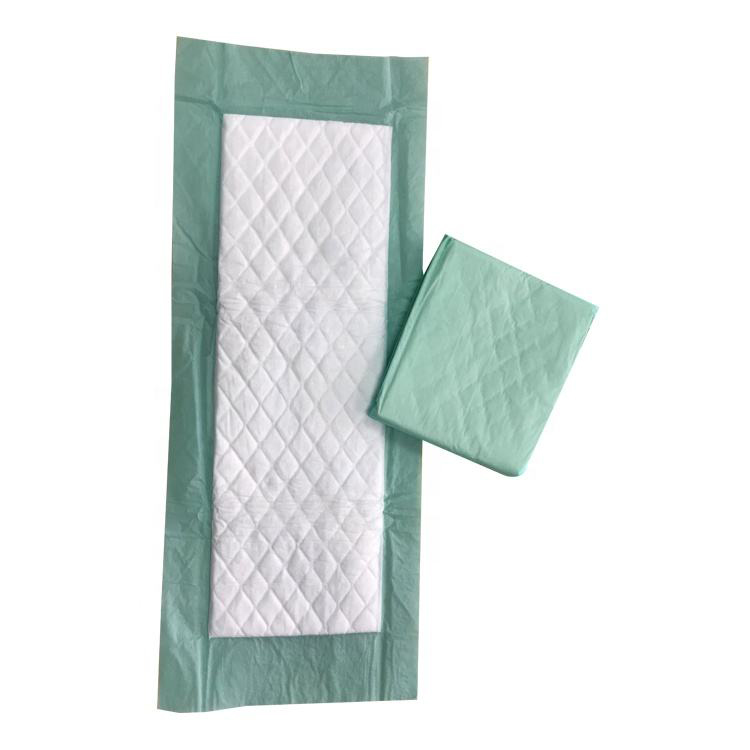
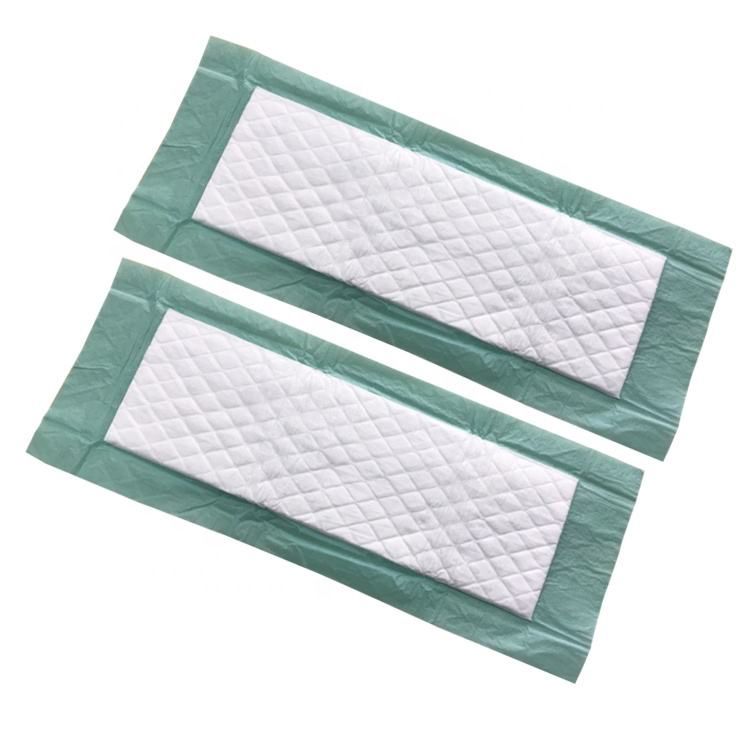
A 60 × 90 cm product with a narrow absorbent core is not functionally equal to another 60 × 90 cm product whose core extends closer to the sealed edges. The non-absorbent border, core centering, and allowable core drift can materially change usable protection even when the printed dimensions match.
Standard Underpad Sizes Turn Purchasing Data Into Usable Evidence
Institutional purchasing depends on aggregation. Aggregation depends on comparability.
Without standard underpad sizes, the procurement team cannot confidently combine annual demand from several wards, facilities, or regional operators. One location orders 60 × 90 cm pads. Another orders “large.” A third orders 23 × 36 inches. A fourth buys a product that measures 60 × 90 cm overall but has a much smaller core.
The spreadsheet says four products.
The care system may be buying two genuinely different products and two duplicates hidden behind inconsistent language. Or it may be buying four products that look similar but perform differently. Nobody knows until someone physically measures them.
And that is the hard truth: SKU proliferation often survives because no one wants to challenge inherited descriptions.
The broader medical-supply evidence is difficult to ignore. A 2017 U.S. Government Accountability Office review of Veterans Affairs medical and surgical supply purchasing reported that one leading hospital network achieved a stated goal of $100 million in medical-supply savings during the first two years of its standardization effort, followed by approximately $35 million annually in later years. The figures covered medical supplies broadly, not underpads alone, but the purchasing lesson is directly relevant: standardization gives institutions a cleaner demand base and stronger negotiating position.
I would not promise that reducing four underpad sizes to three will magically generate an eight-figure saving. That would be nonsense.
But the mechanism is real:
Consolidated volumes become visible.
Comparable suppliers can bid against one specification.
Pack and carton requirements become easier to align.
Warehouses hold fewer near-duplicate SKUs.
Staff training becomes simpler.
Consumption reports stop mixing unlike products.
Supplier changes can be evaluated against the same dimensional baseline.
Price negotiations improve because the buyer is no longer purchasing fragmented demand.
Standardization Makes Tender Comparisons Less Deceptive
Tender documents often request a finished size, a total absorbency claim, a backsheet description, and a unit price. That looks precise. It is not.
Underpad bids can still differ in:
Absorbent-core length and width
Fluff pulp and SAP distribution
Acquisition-layer construction
Strike-through speed
Rewet under pressure
Edge-seal dimensions
Core shifting tolerance
Backsheet friction
Pieces per bag
Bags per master carton
Pallet utilization
A low-priced 60 × 90 cm pad may contain less usable absorbent area than a slightly more expensive pad with the same finished dimensions. If the smaller core causes extra changes or exposes bedding during repositioning, the cheaper bid becomes a false economy.
Institutional teams should therefore use a standardized dimensional family alongside the performance checks in this hospital and nursing home underpad procurement checklist. The checklist emphasizes intake speed, rewet, fit, coverage, backing grip, packaging discipline, and repeat-order consistency rather than treating laboratory capacity as the entire decision.
Underpad Dimensions Affect Workflow Before They Affect the Purchase Price
Procurement teams buy by unit. Care teams experience products by event.
That mismatch causes bad decisions.
A pad that costs less per piece can increase the number of positioning corrections, linen changes, waste-bag movements, resident disturbances, and stock-room trips. Those effects rarely appear in the original price comparison because the spreadsheet captures acquisition cost, not the care episode.
I prefer a harder question:
How much does it cost to protect the required surface for the required time without an avoidable reset?
That is a better institutional purchasing metric than price per pad.
Undersized Pads Reduce Placement Tolerance
Caregivers do not place every underpad with laboratory precision. Residents shift. Beds articulate. Staff turn patients. Hoists move bodies laterally. Chairs have seams, contours, and gaps.
A smaller underpad may perform well when perfectly centered but fail after a 10 cm shift. A wider pad gives the caregiver more placement tolerance, although the institution pays for the additional material.
That trade-off should be measured, not guessed.
For each size family, test:
Placement time
Coverage after turning
Edge exposure after repositioning
Bunching or sliding
Number of full linen changes
Pads used per occupied bed day
Waste volume
Staff acceptance
Resident comfort complaints
A size decision made without ward trials is just a packaging decision dressed as clinical procurement.
Oversized Pads Also Create Waste
Bigger is not automatically safer.
An oversized underpad can increase carton volume, warehouse space, waste mass, and unit cost. It may bunch on a narrow chair, interfere with transfers, or encourage staff to use one expensive bed pad where a compact surface pad would have worked.
So I reject both lazy extremes:
“Use the smallest pad because it is cheaper.”
“Use the largest pad because it covers more.”
The right answer is application-based standardization.
A facility might approve 40 × 60 cm for chairs, 60 × 90 cm for routine beds, and 75 × 90 cm for defined high-movement cases. Staff then receive a simple usage rule rather than access to seven overlapping dimensions.
Size Alone Cannot Compensate for Weak Underpad Performance
Here is where institutional buyers sometimes overcorrect. They discover coverage failures and immediately order a larger disposable underpad.
But a larger pad with slow intake can still allow liquid to travel across the surface. A larger pad with weak retention can still return moisture under body pressure. And a wider pad with a slippery backsheet can still move away from the target zone.
Dimensions control the protected area. They do not prove absorbency performance.
The site’s guide to comparing underpad intake speed with fluid retention explains the operational difference clearly: strike-through describes how quickly fluid enters the core, while retention and rewet testing indicate whether that fluid remains locked when pressure is applied.
A usable institutional specification needs both dimensional and functional requirements.
The Clinical Evidence Supports System-Level Evaluation
A small one-month, multicenter, single-arm study involving 40 skilled-nursing-facility residents, with an average age of 83, evaluated a superabsorbent moisture-vapor-permeable underpad alongside two-hour wetness checks and an existing skin-care protocol. Reported incontinence-associated dermatitis prevalence fell from 62.5% at baseline to 15.4% by week four, while average daily containment cost was reported as $1.40 versus $2.48 for products used before enrollment.
Those numbers are interesting. They are not a blank cheque for marketing.
The study lacked a control group, involved only 40 residents, and was sponsored by Medtronic. The protocol also included regular wetness checks, position changes, cleansing, moisturizing, and skin protection. In other words, the results cannot be attributed to size—or even to the underpad alone. The evidence supports evaluating the full product-and-care system rather than selecting hospital underpads from one headline specification.
The AHRQ pressure-ulcer prevention toolkit also identifies immobility and incontinence as pressure-injury risk factors, notes that moisture-macerated skin tears more easily, and states that skin cleaning should occur when soiling happens and at routine intervals. Size standardization will not replace nursing assessment or timely changes, but predictable coverage can support a more repeatable moisture-management workflow.
That is the defensible position.
How to Build an Institutional Underpad Size Standard
A useful standard should fit on one controlled specification sheet. It should not require staff to interpret sales brochures.
1. Map the Actual Surfaces
Record the usable width and length of:
Hospital beds
Long-term-care beds
Bariatric beds
Wheelchairs
Recliner chairs
Examination tables
Procedure surfaces
Do not standardize disposable underpad dimensions before measuring what they are meant to protect.
The term “60 × 90 cm underpad” should never allow the supplier to shrink the core quietly while keeping the outside dimensions unchanged.
3. Assign One Use Case to Each Approved Size
A clean size matrix might state:
Compact: chairs and examination surfaces
Standard: routine beds and short-duration protection
Extended: dependent users, overnight backup, and repositioning
Special: bariatric or equipment-specific use after authorization
This reduces preference-based ordering. Staff select by use case, not habit.
4. Lock Pack and Carton Configuration
A dimensional standard without packaging control is incomplete.
Switching from 10 pieces per bag to 12, or changing the number of bags per carton, can distort ordering data, storage capacity, tender comparisons, and unit-of-measure settings in enterprise resource planning systems.
Specify:
Pieces per bag
Bags per carton
Total pieces per carton
Carton dimensions
Net and gross weight
Lot-code format
Barcode level
Pallet configuration where required
5. Test Size and Performance Together
Run side-by-side trials using the same fluid volume, application rate, loading pressure, placement protocol, and observation period.
Measure:
Finished dimensions
Core dimensions
Strike-through time
Rewet
edge leakage
Backsheet strike-through
Pad movement
Coverage after repositioning
Consumption per shift
Linen changes per occupied bed day
And do not approve a product solely because the laboratory capacity number is higher.
6. Control Substitutions
An approved substitute should meet the same dimensional family, minimum absorbent zone, performance thresholds, packaging configuration, and labeling rules.
“Equivalent large underpad” is not acceptable substitution language.
The substitute might be larger externally but smaller where it counts. Or it may fit the bed yet create new problems with folding, storage, backsheet grip, or carton volume.
7. Connect Underpads With the Primary Continence Product
Underpads are usually secondary surface protection. They should not be used to compensate for a poorly fitted brief, delayed change routine, or under-specified primary product.
Facilities reviewing total consumption should study the workflow for pairing briefs with underpads to reduce unnecessary linen changes. A correct brief manages the main leakage event; the correctly sized underpad protects the surface when breakthrough, positioning error, or care-related spills occur.
The Purchasing Metrics That Actually Matter
Price per piece is useful. It is not enough.
I would track the following by size family, ward, and supplier:
Metric
Why it matters
Pads per occupied bed day
Shows whether a cheaper pad increases consumption
Linen changes per 100 bed days
Connects underpad performance with laundry workload
Leakage incidents per 1,000 pads
Makes supplier and batch comparisons possible
Cost per protected bed day
Combines price and usage frequency
Cartons consumed per month
Supports replenishment and warehouse planning
Dimensional nonconformities per lot
Detects converting drift
Staff complaints by reason
Separates size, sliding, softness, leakage, and packaging failures
Emergency substitution frequency
Reveals inventory and standardization weaknesses
Approved-SKU compliance rate
Shows whether wards follow the standard
Waste volume per care unit
Identifies unnecessary oversizing
The purchasing department should also record size-related complaints separately from absorbency-related complaints.
“Leaked” is too vague.
Was the pad too narrow? Was it placed incorrectly? Did fluid run across the topsheet? Did the core release moisture under pressure? Did the pad shift? Did the backsheet tear? Did a ward receive the wrong size because two cartons used similar labeling?
Without that classification, the institution will keep solving the wrong problem.
FAQs
What are standard underpad sizes?
Standard underpad sizes are an institution’s approved finished dimensions and absorbent-area specifications for defined surfaces and care situations, such as chairs, routine beds, high-movement patients, or bariatric equipment. The standard normally includes dimensional tolerances, core placement, sealed borders, pack configuration, and rules governing which departments should use each size.
There is no single worldwide dimensional set that every hospital or nursing home must adopt. Institutions should build their own controlled families from surface measurements, care patterns, local supply conditions, and validated product trials.
How do institutions choose the right underpad size?
Institutions choose the right underpad size by matching the protected surface, patient movement, placement tolerance, care duration, fluid exposure, primary continence product, and staff workflow to a measured finished size and minimum absorbent area. The selection should then be verified through ward trials rather than relying on labels such as small, large, or heavy-duty.
The best trial compares coverage after repositioning, pad movement, leakage events, linen changes, consumption per shift, and staff feedback.
What is the best underpad size for hospitals?
The best underpad size for hospitals is the smallest validated dimension that consistently protects the required surface throughout the intended care interval without excessive repositioning, leakage, bunching, or linen changes. Because examination tables, chairs, standard beds, and bariatric beds differ, most hospitals need a controlled family of sizes rather than one universal product.
A commonly purchased 60 × 90 cm format may suit many bed applications, but the usable absorbent-core dimensions still need to be specified and tested.
Should nursing homes standardize on one underpad size?
Nursing homes should standardize on a limited number of underpad size families, not force every resident and surface into one dimension. A controlled portfolio normally includes a compact chair or examination size, a routine bed size, and an extended-coverage option reserved for residents whose movement, dependency, or care duration justifies it.
Using one large pad everywhere may simplify ordering, but it can raise material cost, waste volume, carton demand, and storage pressure.
Are disposable underpad dimensions more important than absorbency?
Disposable underpad dimensions and absorbency address different failure risks, so neither should be evaluated alone. Finished and core dimensions determine the protected area and placement tolerance, while intake speed, fluid distribution, retention, and rewet determine whether the pad captures liquid quickly and keeps the user-facing surface acceptably dry under pressure.
A large pad with weak intake can leak at the edge. A highly absorbent but narrow pad can expose bedding after the user turns.
What should an institutional underpad tender specify?
An institutional underpad tender should specify finished length and width, minimum absorbent-core dimensions, dimensional tolerances, core position, sealed-border requirements, topsheet and backsheet construction, intake and rewet test methods, packaging quantities, carton labeling, lot traceability, defect thresholds, approved samples, substitution rules, and the intended use case for every requested size family.
The tender should also define how bids will be normalized, such as cost per pad, cost per square meter of absorbent area, carton volume, and trial performance.
Standardize the Specification Before Requesting the Quote
Underpad size standardization is not administrative tidiness. It is a way to make products comparable, aggregate purchasing volume, reduce hidden substitutions, simplify staff decisions, and connect unit prices with actual care outcomes.
But do not standardize blindly.
Measure the surfaces. Define the use cases. Separate finished dimensions from absorbent-core dimensions. Test intake and rewet. Lock the pack configuration. Track linen changes and consumption. Then remove duplicate SKUs that cannot justify their existence.
For institutional procurement, private-label development, or bulk replenishment planning, review the available disposable and reusable underpad product range and submit a controlled dimensional matrix through the OEM/ODM manufacturing program. Ask suppliers to quote against one exact specification—not against the word “large.”